
When it’s time to approach teaching modes to a student, I have to take a deep breath and prepare myself. I’ve had students tell me that they feel like their brain is going to “melt out of their ears” after learning about them. And I completely understand what they mean!
I remember feeling the same overhelm when I walked in their shoes (or sat on their bench, rather). Knowing that a Lydian mode contains a sharp 4 is all well and good. But if they can’t hum, sing, or even hear it in their head, it’s difficult for them to really know what that sharp 4 means. But I’ve found that having students play fun piano music using modes helps them to internalize the way that mode sounds.
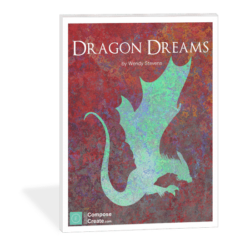
It’s much easier for a student to remember the “Dragon Dreams” melody than a Lydian scale. Does “Dragon Dreams” replace a solid understanding of how that mode is made? Definitely not. But, it serves as a helpful tool for students when first learning something that feels very heady.
What do you mean by “fun piano music using modes”?
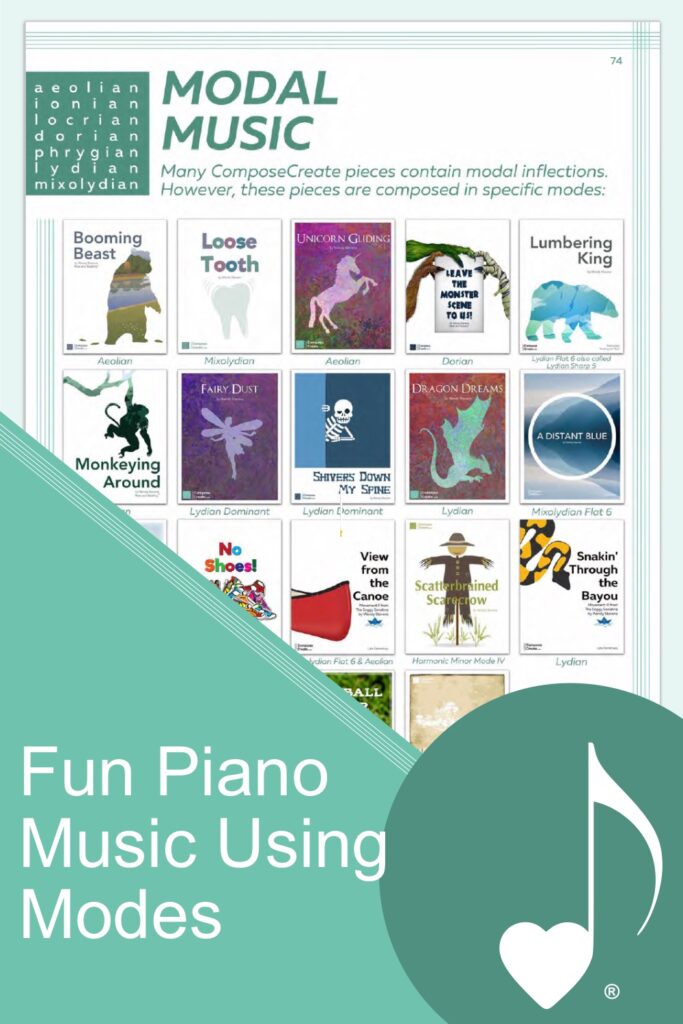
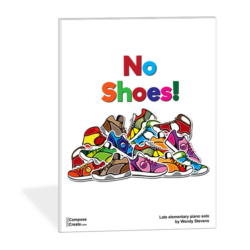
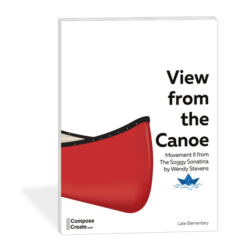
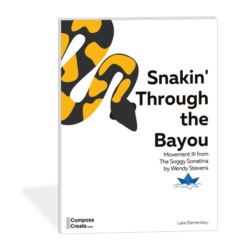
Many ComposeCreate pieces contain “modal inflections,” but there are several pieces that are written in a specific mode. These pieces span elementary through intermediate levels.
What this means is that students don’t need to know everything about modes to experience what they sound like! The best part is, all of our piano music using modes is Music Kids Love®, so that means they’re fun to play, which motivates students to practice.
Some pieces are written in a particular mode – Aeolian, Dorian, etc. Some of our pieces offer even more harmonic inflection by using things like “Lydian Dominant”, or “Mixolydian Flat 6”.

How can I use pieces that focus on modes?
ComposeCreate music can be used in many ways: replace a piece in a method book that you don’t enjoy, give students extra practice in an area with which they need more time, recitals, or the 30/40 piece challenge, just to name a few. In addition to the ways we typically suggest using our music, here’s how to use fun piano music using modes:
- Reinforce theory: If your student is learning about modes for the first time (or even reviewing), learning pieces in a specific mode are a great way to help them really internalize how that mode sounds within the framework of a melody, harmonic movement, etc.
- Sight reading practice: Because modal pieces tend to have more accidentals, they can be a wonderful sight reading challenge for students. Giving a student a modal piece that is a couple of levels below their current playing level is a great way to see where their sight-reading skills are.
- Introducing new sounds: Many modes sound interesting or even confusing to students simply because they’ve never been exposed to music in those modes before. But students of all ages and abilities can and should learn to appreciate and play music that is different from what they typically listen to!
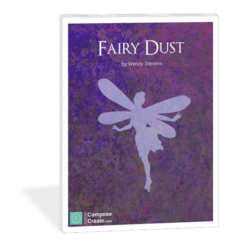
- Communication in Music: What is it about the Aeolian mode that makes “Unicorn Gliding” sound magical? Why does the Lydian Dominant in “Fairy Dust” make that particular piece sound twinkly and fairy-like? Understanding how different intervals or harmonic inflections work together to communicate a specific sound is a fantastic gateway for students becoming interested in composing.
Which ComposeCreate pieces are written in specific modes?
We have an entire page in The Student Solutions Catalog dedicated to pieces written in specific modes. If you haven’t downloaded this free resource, you can find out more and download it here. Hundreds of teachers use this 117-page resource that was specifically designed to make finding music easy and quick.
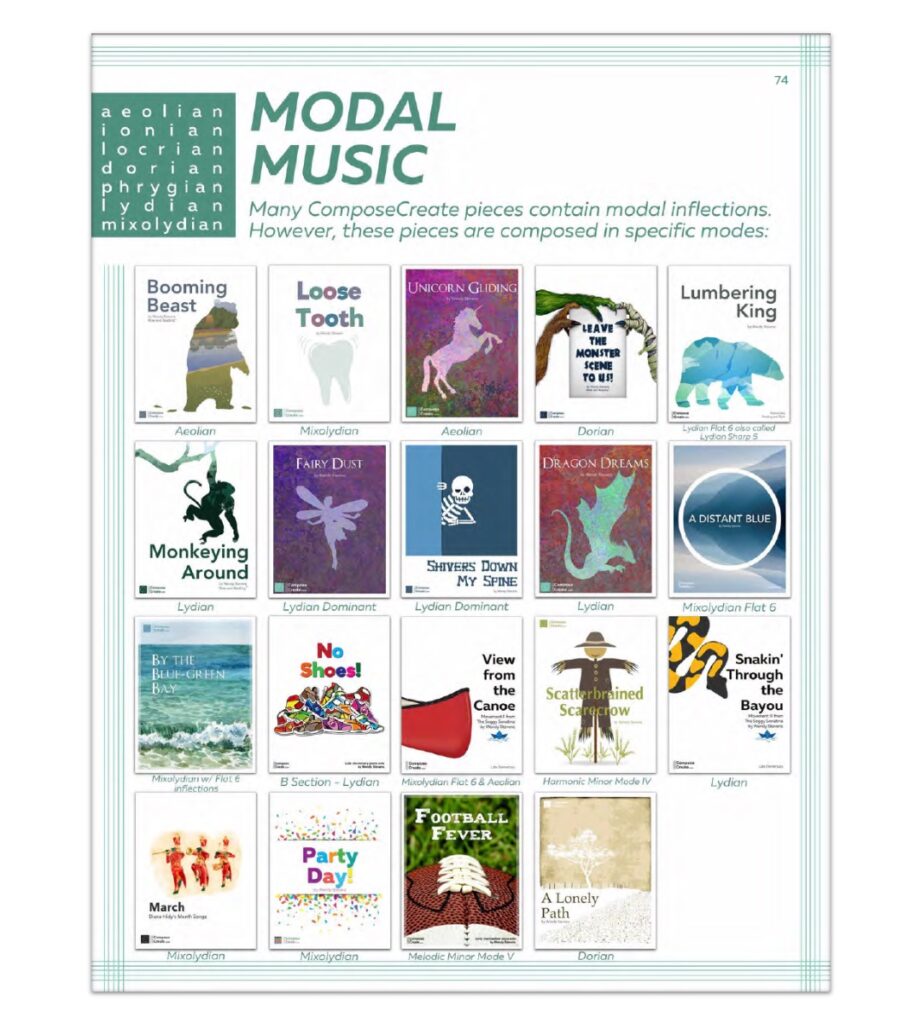
This catalog is easy to use, and all of the pictures are clickable. If you see a piece that interests you, just click on it and you’ll be taken to the product page! Even pieces in the Table of Contents can be clicked. Not only can you find music based on a theme (like easier than it sounds), but you can search for pieces that solve specific problems, holiday music by level, themed music, resources, games, and so much more. There are many, many ways to use this catalog – you can find some wonderful ideas here.
Download the FREE Student Solutions Catalog here!
Modal Music Available:
-
 $10.99
 -
 $10.99
 -
 $10.99
 -
 $10.99
 -
 $10.99
 -
 $10.99
 -
 $10.99
 -
 $10.99
 -
 $10.99
 -
 $10.99
 -
 $10.99
 -
 $10.99
 -
 $10.99
 -
 $10.99
 -
 $10.99
 -
 $10.99
 -
 $10.99
 -
 $10.99
 -
 $10.99
Want to be notified when we have new idea shares and webinars?
If you are a piano teacher and want to know when articles like these get published, please join our email newsletter! We send out weekly newsletters with articles, new music notifications, free webinar opportunities and free teaching resources! We’d love to have you a part of the ComposeCreate community.

