
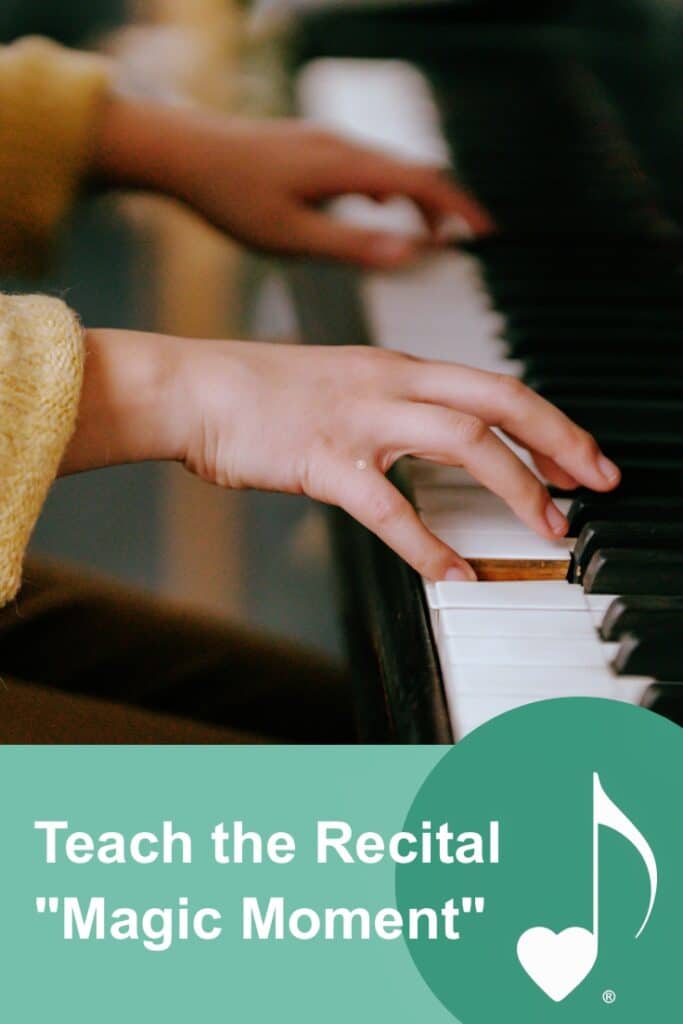
Recently, at one of our ComposeCreate® webinars, we shared tips on how to prepare students for their music recitals. I shared about the“Magic Moment” I teach my students to help them look polished. A helpful mentor along my teaching career shared this tip with me, and I wish I recalled who that was so I could credit them. Our community was really interested in the Magic Moment, so here’s a post all about it! While this post is geared toward teaching piano students, the Magic Moment can be used with any musician, or any performer.
What is the Magic Moment?
The Magic Moment is that split second after a pianist finishes playing their piece, but before the audience realizes the piece is over. It’s a moment where students either look amazing and professional or ordinary and unprofessional. It’s that moment where student can end their piece artistically instead of quickly. It’s very simple.
The magic of the Magic Moment just means that the student gently floats their hands off the keys and into their lap after they end the last measure.
That moment crackles with anticipation – something special happens in a room of people when time is suspended, even for a split second! Here’s the anatomy of the Magic Moment:
- The student finishes their piece, but before they get up –
- They gently float their hands into their lap, signaling that the piece has finished.
- The audience receives the cue to clap for the performer,
- And the student bows, perhaps collects their music and walks off the stage, looking polished.
It’s easy to overlook a moment of poise before bowing or leaving the stage, but it’s a valuable skill worth teaching a student. Teaching this special moment really takes root with kids. Once students understand what’s involved in the Magic Moment, the alliterative name makes it easy for you to refer to – and for them to remember!
How do I teach the Magic Moment?
Here’s how to teach the Magic Moment to ensure your students remember it. I love to use funny narrative to demonstrate the importance of it.
Mime the elegance of a Magic Moment, then juxtapose that elegance with the opposite. Mime unceremoniously finishing your piece, slouching when done, and scuttling away from the piano. Extra points if your face looks grumpy. By hamming up the difference between the performer with good poise and the one who practically runs from the piano at the last note, and your students will remember the difference, and giggles will abound!
In those weeks leading up to the recital, it’s so important – especially with first-timers – to reference the Magic Moment, and practice what they’ll do at the recital. You can also reinforce it at other times by saying things like, “Remember to end your piece with the Magic Moment today!” Or even better, catch them ending a piece in a lovely way and praise them for their beautiful Magic Moment.
How do I use the Magic Moment for recitals?
We’ve all done “runthroughs” of what students should do when they finish their piece at a recital. There are resources out there for preparing your student for recitals weeks and months in advance. In my studio, I tend to keep it simple. In the weeks before the recital or performance, the student and I sit on the couch together (away from the piano), then direct them to pretend like it’s their turn. Then we run through their recital etiquette, too. I tell them:
- Get up from their seat with your music
- Approach the piano
- Bow from the hip (and look down at shoes to make sure your shoelaces are tied)
- Then have a seat and adjust the bench
- Play the piece.
- Finally – end the piece with the Magic Moment
- Rise again, bow again (make sure your shoelaces are tied again)
- Go to your seat!
I also let students know that recitals are like practicing playing for other people. By the time they’re older, they’ll feel less nervous, since they’ll have practiced playing at recitals more times!
Last minute tip for recital poise
Finally, here’s a quick tip that I always do for recitals, no matter what student order I choose. I ask an extroverted/confident student to go first so they can model the Magic Moment, and all the nice etiquette for recitals, like bowing. At the recital, I thank the student for going first and reminding everyone else “how it’s done!” This is a nice start for a recital, because anyone less experienced can see what they were taught to do.
Try the Magic Moment and these tips and let me know how it works for you and your students!


I really like the alliteration of ‘Magic Moment’, especially for kids. They are drawn to the word ‘magic’! I recently attended a presentation by Ingrid Clarfield, and she talked about the same thing, using the word ‘gesture’, ie the physical gesture (of the whole body, and especially the hands) before playing, and at the finish of the piece, should reflect the nature of the piece. A quiet, flowing piece should begin and end with a quiet, graceful gesture, onto and then off the keys. A fast piece with a flashy ending might end with the hands in the air! But that ‘magic moment’ can (and should) happen with either kind of ending.
A fun phrase I learned from a wonderful Suzuki violin teacher, for the brief moment you spend in that pre-and post-performance bow, is ‘hippopotamus’ — just long enough for a bow, so students don’t just bounce down and up. I also like ‘hello, shoes!’ which I got from a pedagogy teacher. I actually have students practice the whole performance process at the 2 or 3 lessons before a recital or performance, and even at a recital, with the entire audience practicing bowing. They get a kick out of it, and sometimes I have the students stand in front, giving the demo, then having the parents copy them, with a vote on which group made a better bow.
Let me add that in my experience, both as performer and audience member, I have always thought that the object of any performance should be some kind of audience response relative to the nature/mood of the piece. In my mind, I sometimes feel if the musical performance makes the audience cry — or roar — it is a success! Our community orchestra plays for an audience made up of ‘experienced concert-goers’ ie those who know not to clap between movements of a symphony, and newbies who think clapping constantly is the thing to do. Our conductor has mastered the art of holding arms raised and body still between movements, while players turn pages, etc to keep the audience from clapping. MOST of the time, it works.
I love the idea of invoking “magic” for that special pause at the conclusion of a performance piece. I tell my students that after they finish playing their “hands go in their lap so the audience knows it’s time to clap” (said in a rhythmic, poetic style 😉