
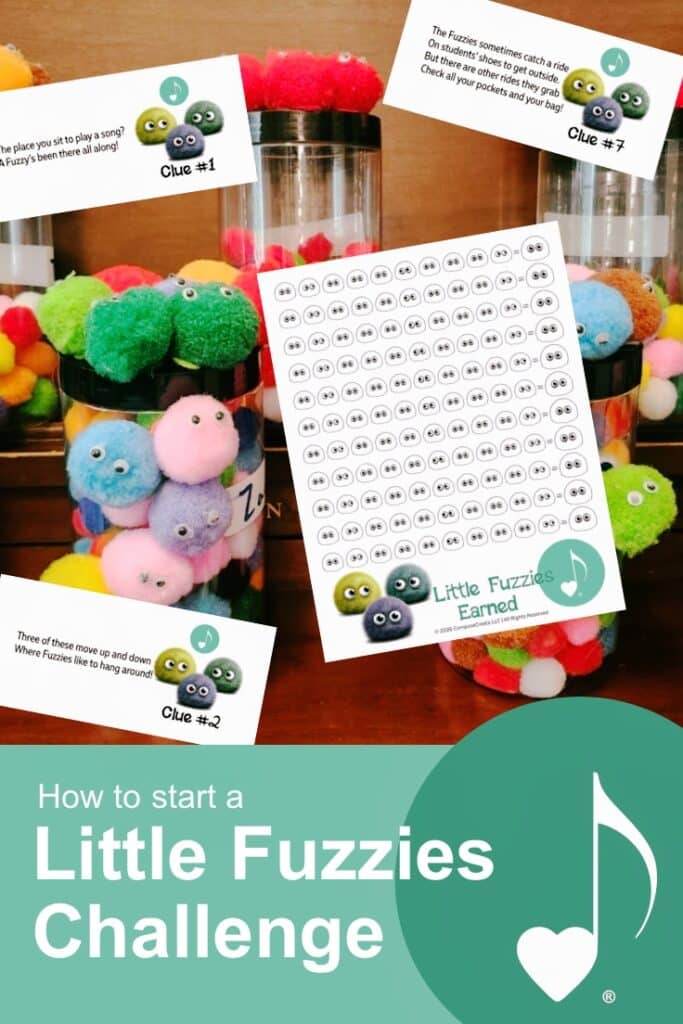
At the UMTA 2025 conference, Melissa Bearden told me about a super exciting challenge she had created for her students last summer. I was immediately intrigued and excited with its ingenuity and she gave me permission to build on her ideas and then share the ComposeCreate version of this Little Fuzzies Challenge program with you!
This is a great summer challenge because it can be short! But it works during the year as well. You can also adapt this challenge to motivate students to practice and complete special music tasks during the summer to watch their Little Fuzzy collection grow!
Here’s how it works:
- Students complete a variety of tasks during the week.
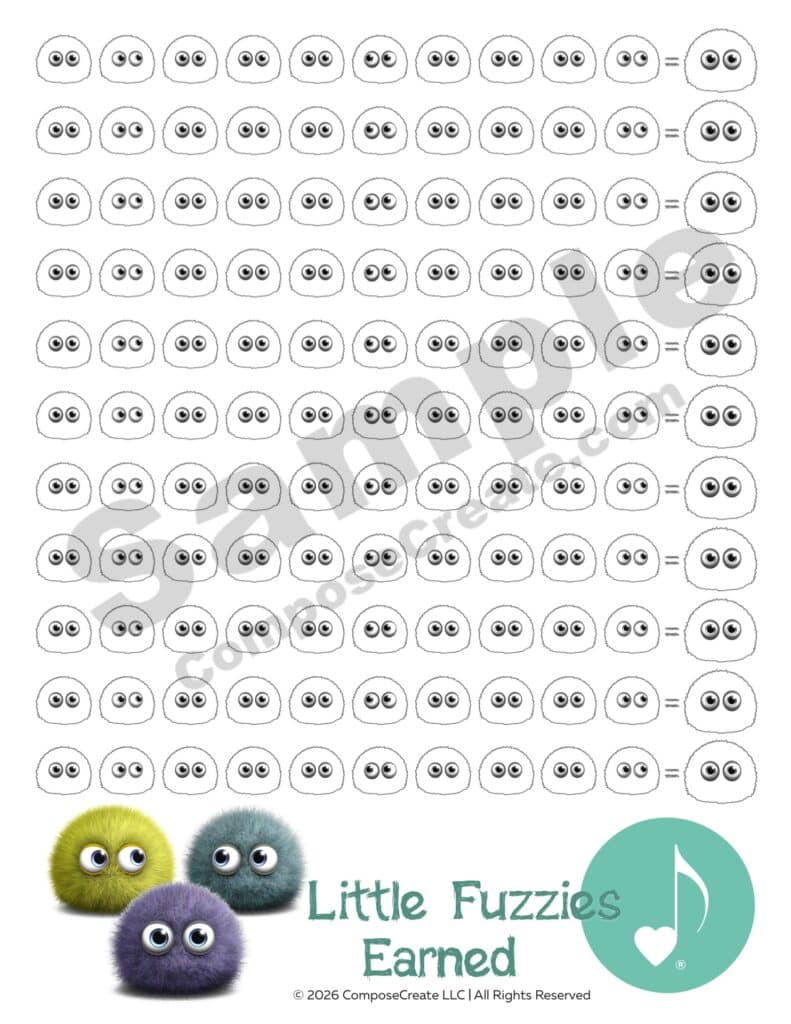
- At the lesson, the teacher awards the student with Fuzzy pom-poms to go in their bucket (or jar) each week. Students also color in the corresponding number of Little Fuzzies on their Fuzzies Tracker (provided by us).
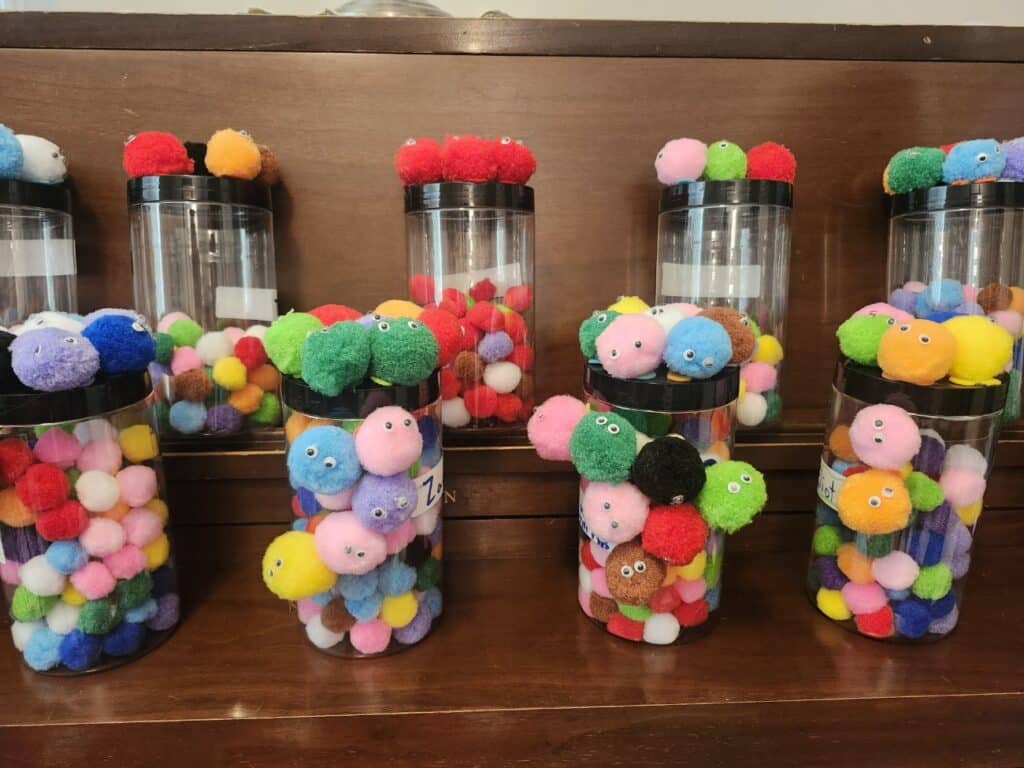
- Over time the number of pom-poms will grow and grow creating a great visual effect.
- For every 10 Little Fuzzy pom-poms they earn, students can stick eyes on a Little Fuzzy attach it to the top of their jar.
- At the end or beginning of your challenge, you can host a Little Fuzzy party where students can play their favorite pieces, bring Fuzzy Treats, and play the special Little Fuzzy Scavenger hunt that we will give you to you!
How do students earn a Fuzzy?
You can create your own list of tasks (we include an editable file), but here are our suggestions based on what Melissa Bearden has already tried:
- 1 week of complete practice. Or you can give a pom-pom for every day of practice!
- Accurately play one page of Summer Fun Music at the lesson.
- Accurately clap and count 1 page of Rhythm Menagerie® or Rhythm Manipulations®.
- 1 completed theory page (max 1/day).
- Listen to and write about 1 piece of music (2-3 musical details).
- Draw a picture of the Little Fuzzies doing something fun (max 1/week).
- Write a handwritten letter to a composer to send in the mail.
- Memorize a piece of music you are learning.
- Perform a piece for family or friends.
What I really love about this list is that it not only rewards good practice habits, but it also provides students the opportunity to be creative, to use their imaginations, to write a litter, to draw a picture, and other things that kids are not doing as much these days because of digital addictions.
What music counts?
While you can use any music students are working on for this challenge, Melissa noted that her students loved music that was new and hand-selected by their teacher, but she also allowed method book pieces to count.
Hand selecting music not only gets students excited, but it also saves the teacher from negotiations! And as we all know with the 30 Piece Challenge, there is a lot of discussion about what counts and what doesn’t! So hand selecting your list can be important.
Especially useful music series include:
- Little Fuzzies Series
- Mythical Creatures
- Pet Shop
- Month Songs (great for older students)
- Short Sheets® (these can be found for all levels of student)
- Tune Up Tunes®
Materials Needed:
Here are the materials you’ll need to do this Little Fuzzies Challenge:
- Jars with lids
- A way to label the jars with student names
- 1 1/2″ sized pom-poms (for the top of the jars – 1 bigger Fuzzy for 10 smaller Fuzzies earned)
- Smaller “marble-sized” pom-poms to go inside the jar
- Googly eyes
- A way to affix the regular sized Little Fuzzies to the top of the jar (read Wendy and Melissa’s tips below!)
- 1 Little Fuzzy Tracker chart per student
- Your Summer Fun Music list
The great news is that we are providing the charts for you for free! All you have to do is acquire the pom-poms and eyes and create a list of music for your students to use. To see what pom-poms Melissa used and to see what self-adhesive eyes might work well (so you don’t have to use hot glue), read the interview with Melissa below.
Celebrate with a party and Little Fuzzies Scavenger Hunt (free!)
You can celebrate the completion of the challenge with a Little Fuzzies party! This will include an exciting Scavenger Hunt where students figure out special clues to find Little Fuzzies all over your studio! We are giving you these 9 clues for free and you can even create your own with the blank card!
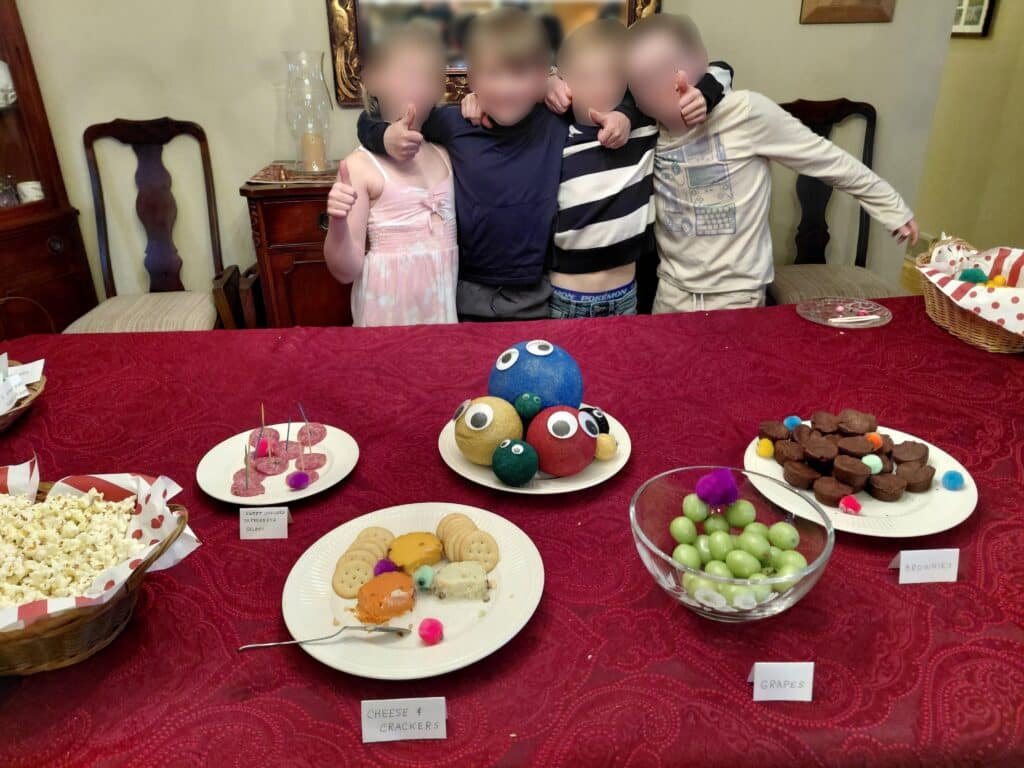
Students can also play their favorite Little Fuzzies piece for each other and then everyone can relax eating Little Fuzzy Treats. These would be any foods that are round or circular! You can even ask parents if they would like to bring something. Here are some suggestions:
- Grapes
- Round crackers and cheese
- Mini round brownies (see picture)
- Popcorn (it’s kind of round!)
How to adapt this if you don’t teach in the summer
We know many teachers opt not to teach in the summer, so here are a few ways you can adapt this to still challenge your students:
- Send a bag of pom-poms and a jar home with students so that they can watch their fuzzies grow at home.
- Send a notebook of pieces home with students (studio licensed music is so handy here) that is just barely at or below their level. That way, they aren’t running into new concepts without you.
- Remind students that our newer pieces have QR codes on them so they can hear what they sound like.
- Simplify the ways students can earn Fuzzy pom-poms (use the editable file). I would allow students to earn 1 Fuzzy per every DAY they practice. They’ll need extra motivation to keep them going without you, so rewarding every day practice is helpful here. I might also take away some of the others things that require a lot of checking from you.
- Make sure you let parents know what’s happening so they can get on board.
Q&A with Melissa Bearden
We asked Melissa some questions that we knew you’d have and she graciously answered these in detail! Here is our interview with Melissa:
What was the overall student reaction to this Challenge?
Students were excited and curious. They wanted to start filling jars immediately! Occasionally a piece needed more work, but that didn’t happen often once students knew what I expected. The 7 year old students and the high school seniors wanted to see what they could accomplish in the allotted time – they worked on different pieces of course, but with the same same expectations.
Can you describe the effectiveness of the Challenge in your studio?
The immediate satisfaction of passing off a piece was motivating for every student! Even those that didn’t practice as regularly were still working on Fuzzy pieces (even if nothing else got worked on that week). The constant newness of the new pieces kept their attention from week to week.
One student who found no enjoyment in piano started to notice he didn’t have as many fuzzies as some others. He started to put more time into his Fuzzy pieces for this challenge. He still didn’t enjoy piano, but was excited to see his Fuzzy jar start to fill.
Where did you get the plastic jars with lids?
Amazon (my favorite place to order at 2AM). There were several options, but I chose these jars that wouldn’t tip or break easily.
Fuzzies in the jar are small pompoms likes these, about the size of a marble.
Fuzzies on top and sides are bigger 1.5 inch pompoms like these.
I used hot glue to glue the eyes on the bigger pom-poms, but this isn’t ideal for student to use – So definitely check out the googly eyes that are stickers like Wendy suggests here!
What about the students who have “aged out” of the Little Fuzzies? How did they respond to the challenge?
My oldest student heading into his senior year of high school was just as excited to watch his jar fill as anyone else. Jr. High age students think they have outgrown this until they see how fun it is to play new music nearly each week and their jar starts to fill up. Some students started looking for specific colors to fill their jar, giving a layered look. My less‐enthusiastic students even got into the challenge when they saw the other jars starting to fill – positive peer pressure at work!
Was there a particular reason you chose specific music to learn? Why didn’t any piece they wanted to play count?
I chose music I owned a Studio License for, or students already owned. I didn’t want this to be an additional expense for parents. Rather, the purpose was to have short pieces or count each page as a piece so students didn’t get bogged down. More variety, more exposure, more, more, more – without monotony or boredom. I chose solid teaching repertoire to ensure skills and concepts were still being learned, practiced, and hopefully mastered. Method books and Repertoire collections were allowed in addition to the Little Fuzzies. Each student had a copy of what was expected in order to pass off a piece (or page). This included:
- Correct notes and fingering
- Accurate rhythm
- Accurate dynamics
- Accurate articulation
- Phrasing and expression
How long did your challenge run?
I started my Challenge after our Spring Break – Mid April – this is the end of our Evaluation season and is a great lead into summer. I have found if we start when school ends, the excitement just doesn’t translate. Starting during the school year helps keep the practice habits we are trying to build. But, a shorter time would be great, too (June/July/August, for example). Even a few weeks could be worth it but maybe use smaller jars. You could do a Mini challenge for the holidays and track from Halloween to December 31 – there is so much wonderful Holiday music to experience!
Did you or the students kept track of on their Little Fuzzy Tracker?
I was the only one who could mark the tracking sheet initially. Once my initials were on the little fuzzy, students could color him/her. I like to believe all students are honest, but don’t really want to test that during a challenge.
Did students keep the tracker in their notebook or at the studio?
Yes. Anything important goes in student binders. I use student binders to manage a little of the chaos. And, if they forget their binder at lesson, they don’t earn anything that week – no one has forgotten a binder yet! I have considered keeping the paper tracking sheets on the walls of my studio so students can see each others, but the jars fulfill that without adding things to my wall.
What would happen if students got a pom-pom for every DAY they practiced instead of week?
I love this! I have also tracked minutes practiced rather than days, but that gets a little complicated when a student usually practices 90 minutes due to repertoire, while another is 6yo and can barely handle 15 or 20 minutes. If you awarded by levels, it could be done. There are even smaller pompoms available – which may be helpful if you are giving 4-7 to each student each week or if you have a longer challenge. Pompoms are relatively inexpensive, but they do add up if you need a lot of them.
What tips do you have for teachers who want to do this challenge?
Use what you already have first. Mason jars are great, marbles, pebbles, beans, anything that can be collected en masse. Also keep it simple and let students do as much as they can so you don’t lose precious teaching time. I originally used glue dots so students could stick fuzzies on top, but found they didn’t stay well and changed to hot glue (I handled this part and let students place the fuzzy before the glue cooled. This was done in place of our end-of-lesson game or activity.
How do you think this could be adapted for teachers who aren’t teaching but still want their students to practice?
Video submissions and paper jars with stickers could work if teachers are teaching, but students are not able to come to lessons. No teacher contact during the summer means the students could learn and polish pieces and earn Fuzzies when the piece is played for a friend or group. The friend or group could sign a signature page and you could award Fuzzy pom-poms at the end of the summer. You could also use a private YouTube channel to collect and share pieces that have been passed off within a Studio. I’d love to hear what ideas other teachers come up with!
Note from Wendy: I think it could be important to have a group lesson before the end of the spring semester so that you can explain the challenge to everyone at once. Then, you can send them home with a notebook of new music (remember the newer pieces have QR codes so they know better how they sound).
What thoughts and questions do you have?

