

I am a major planner. It’s beneficial, but I struggle to implement new music if I don’t know how it will fit into “The Plan”. Introducing a wide variety of music to my students helps them keep learning. But sometimes, I don’t know what in the world to use…or when! Short Sheets® are such a lifesaver for my online and beginner students, but I struggle to know when exactly to introduce a new piece, especially when book and song “levels” can vary so much from publisher to publisher. This is why I absolutely love the new Short Sheets® Leveling Guide that Wendy created!
What Are Short Sheets®?
If you aren’t familiar with our collection of Short Sheets® already, they are Wendy’s answer to online lessons. These sets of three, one-page solos make learning concise, while providing students with fun and pedagogically sound pieces. They’re perfect for Zoom lessons because of the short length. Short Sheets® also make fantastic review pieces and are great for beginners who feel overwhelmed by longer repertoire.
The sets range from Early Elementary to Late Intermediate, and topics cover Dinosaurs to Staying the Course during troubling times. I have gotten more use out of the Short Sheets® Studio License than any other ComposeCreate® piece, especially during COVID! Here’s more information about Short Sheets® if you’re curious about how else to use them in your studio.

What Is the Short Sheets® Leveling Guide?
The Short Sheets® Leveling Guide makes choosing pieces for your students easy and quick, which is something we all need! It also makes knowing where to fit these pieces in among other books much easier. So easy, in fact, that I don’t even have to open the piece to know what students can use it. The guide contains 5 headings: Level, Cover, Name, Contents, and Concepts. Each one is explained below.
- Level: The Level portion is divided into Early Elementary (EE), Elementary (E), Late Elementary (LE), Early Intermediate (EI), Intermediate (I), and Late Intermediate (LI). Each piece is in the guide according to its level/difficulty. Once you know where a student should begin, you can just continue on to the next piece once they’ve finished. More on how the pieces are leveled later!
- Cover: Listed next is a picture of the cover. This makes it easy when you’re looking for pieces on your computer or in your printed library!
- Name: This section includes the name of each piece, along with the link to the product. I love that the link is included because I can purchase the next set of Short Sheets® when needed.
- Contents: This gives the title of each piece in your Short Sheets® set. For example, Pick Your Favorites has the songs “The Best Color”, “Favorite Flavor”, and “Octave Options”. (Note: An earlier version of this guide did not have this feature. Feel free to delete that older guide and download the latest one!)
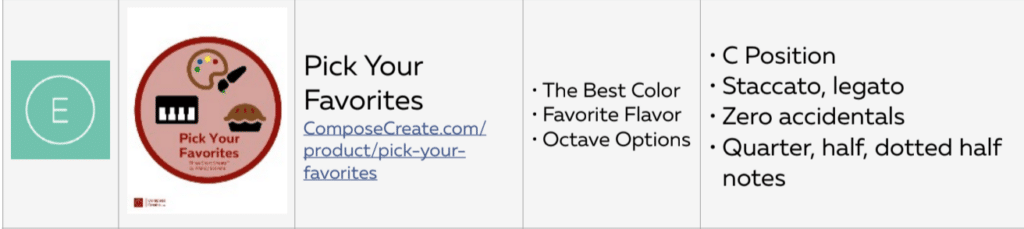
- Concepts: Aside from the level, this is the portion of the Leveling Guide that makes picking pieces so easy. This section tells you what will be covered in the set. Concepts included are hand position, accidentals/key signatures, types of notes/rests, and other helpful items. Knowing this information means I know at a glance whether a particular student is ready for a piece. It really takes the guesswork out, and makes creating lesson plans much easier!
How Is ComposeCreate® Music Leveled?
This is a question we get quite a bit, and I understand why. There is quite a variance between levels depending on the publisher or composer of pieces or method books. There are books labeled “Level 1A” that are the same as “Level 2B” in another series.
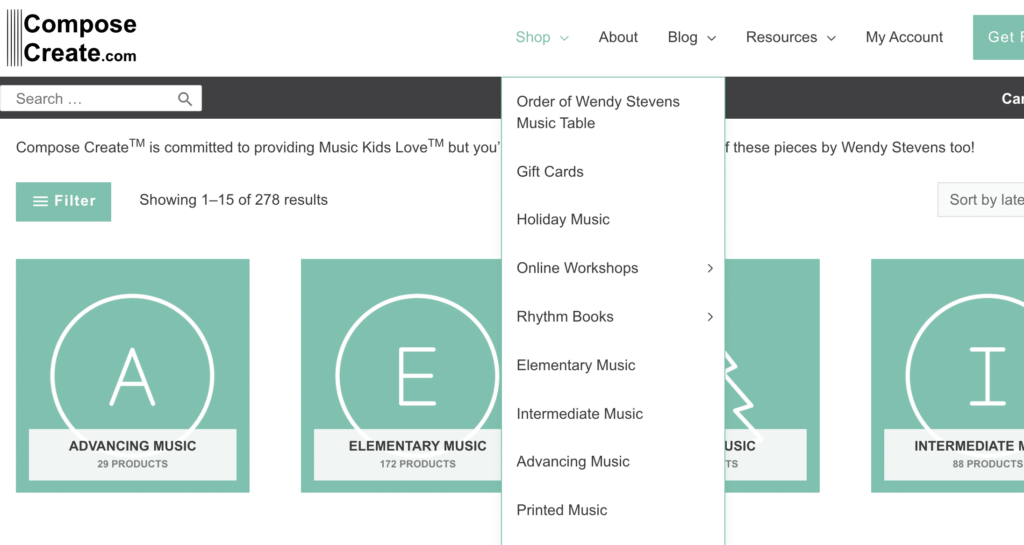
Instead of saying “This piece is equivalent to X method book”, Wendy has things leveled as: Early Elementary, Mid Elementary, Late Elementary, Early Intermediate, Mid Intermediate, and Late Intermediate/Early Advancing. This applies to Short Sheets® as well as all of our other pieces. These terms are relative enough that teachers know where to fit the music in, regardless of their student’s level.
I don’t use one particular book for all elements of teaching, so I now use the same leveling concept as Wendy for all my internal organization. It’s much easier for me to think in terms of “Elementary” rather than “Level 2B in method book”. It also forces me to focus on musical concepts and ideas instead of specific books or repertoire. I’m more likely to try new things because I’m not stuck to particular levelings based on a method book!
If thinking of levels in this way feels confusing, the “Concepts” row in the Leveling Guide really helps. You may not know if your student would be considered Elementary or Late Elementary. But, you do know whether they’ve been introduced to certain hand positions, note values, etc. You can pick Short Sheets® based on that information, and don’t have to even worry about the level title.
How Do I Use the Short Sheets® Leveling Guide?

The beauty of this Short Sheets® leveling guide is that it’s the easiest way to add Short Sheets® into your library. You can literally just go right down the list. After a student has finished one piece, you can look at the concepts covered in the next set to decide whether it’s time for the next! I also find it works wonderfully for sibling sets. I can easily ensure I’m not giving sibling A a piece that sibling B just had a few months ago. Organization is so much easier with everything in one spot!
I’ve also found this leveling guide already is working as its own sort of motivational tool. I have one student who is starting Space Adventures this week, and he knows Fun Foods is coming next and can’t wait to play those pieces. Another student I teach has intense anxiety about new pieces. This anxiety shows up in the form of many, many questions: Does this song have accidentals? Do I have to change hand positions? I love that the “Concepts” row has those answers, and he can look at that guide and know exactly what to expect.
As someone who loves to plan (but finds it so draining these days), this Leveling Guide is a definite time saver for me. You can see and save the Short Sheets® Leveling Guide here free and use it to make your own lesson planning easier!
Let us know in the comments if you’ve started using the Leveling Guide, and if you have any other ideas on using it as a motivational tool for students!
Want to Get These Articles In Your Email?
If you are a piano teacher and want to know when articles like these get published, please join our email newsletter! We send out weekly newsletters with articles, new music notifications, free webinar opportunities and free teaching resources! We’d love to have you a part of the ComposeCreate® community.

Great article! I’ve used several Short Sheets for my beginners. I need to pull some out for some other students!
The article said the Leveling Guide included Contents. The guide I just downloaded did not include it. ???
Thank you, Wendy for this helpful guide. I LOVE Short Sheets and have used almost every one this summer. My students are energized by the pieces AND the fact that they are short. You have made our summer easy and light-hearted. Thank you!
Hi Wendy,
The short sheets levelling guide looks to be quite helpful. I read that the Tune Up Tunes are a subset of the short sheets. Would you mind updating the levelling guide to include all the Tune Up Tunes?
Best regards,
Juli Holgerson
Yes, we plan to do that soon. The goal is to get that out at the “Special Collections” webinar on February 18th. Stay tuned and thanks for letting us know that that guide is helpful!