

This is Part 2 of a new series called The Process of Composing an Elementary Piano Solo.
In the first post of this series, I talked about how I write lyrics for an elementary piece of music. The article told you about the tedious (and fun) process in a careful, need, and linear way. But the truth is, the process of composing music is never linear. Lyrics are often composed simultaneously with the music and each are edited in dynamic and cooperative ways.
The Little Fuzzies pieces are the closest I’ve ever come to composing words independent of the melody, but they certainly weren’t completely separate. However, because the Little Fuzzies pieces require carefully thought-out stories, the lyrics and stories are definitely the first step in the process.
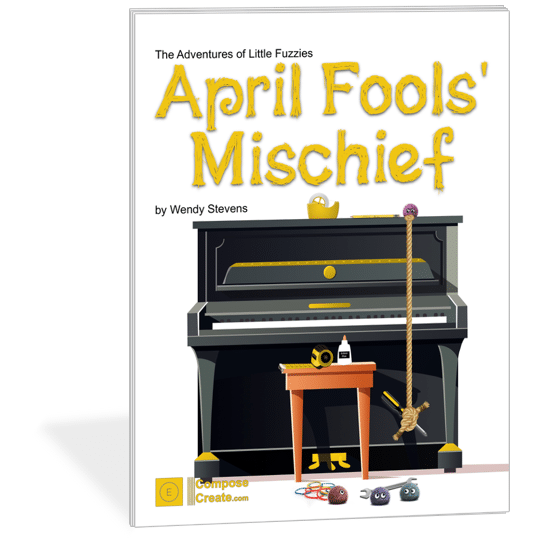
So today, I thought I’d share more of my Composer’s Journal about composing the music for these two early level pieces: Easter Egg Hunt and April Fools’ Mischief. I’m going to switch over to the April Fools’ Mischief piece today because there are more interesting details about how the melody and music interact in this piece.
How Did the Rhythm Come to Be?
This piece unfolded in a more usual way for me – the melody and the lyrics happening at the same time. I’ll tell you how I came up with the April Fools’ Mischief story in a later post, but that first phrase was what got the rhythm going:
“Little Fuzzy’s up to something!”
When you read that, it’s obviously all quarter notes. But because kids play so many quarter notes at this level, I wanted something different, something with a rhythmic hook!
Now here’s a really subtle thing that I discovered. I realized that the word “something” and “somethin'” actually have two completely different rhythms to them. The first is just two straight quarter notes, but when you say, “somethin'”, you’ll notice that the first syllable is emphasized even more and the last syllable trails off. Now you’ve got some sass and pizzazz and now it’s got a rhythm with syncopation that even elementary students can handle.
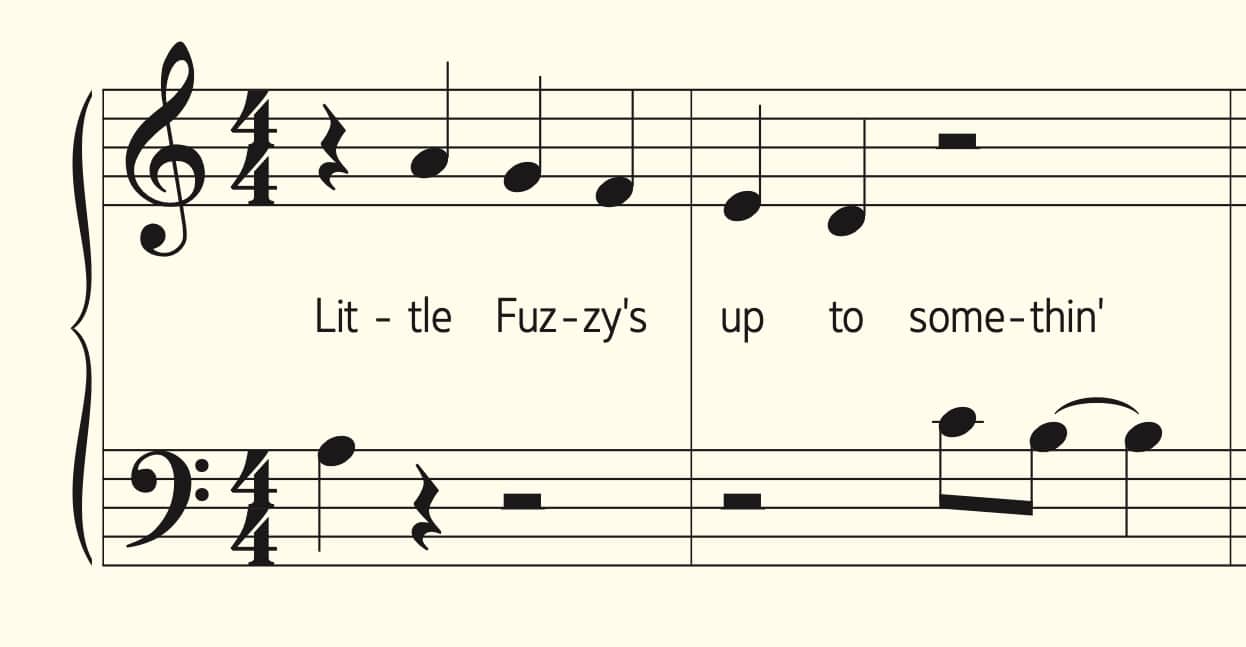
That’s a hook! Something catchy, memorable, and playable for students.
How did I know elementary students could play it without knowing about eighths? It works because how you say the word “somethin'” actually IS the rhythm! You can’t really say that word with just straight quarter notes. Once that rhythm was obvious, I knew the rest of the lyrics had to have a two syllable word at the end of each phrase that would continue to force the student to feel the rhythm in their words and the melody.
What About Composing the Music – the Notes?
It will be more interesting to talk about how I choose notes when I’m journaling about a more advanced piece. But the Little Fuzzies music has always been about learning steps and skips and sharps and flats, so I was limited in how complex the melody could be. There’s a fine balance when writing elementary music because you have to weigh how much complexity a student can handle at one time. Elementary students can certainly handle skips, playing notes together, and an eighth note rote motive…
…but not at the same time!
So a simple descending five finger scale seemed the perfect way to keep the student feeling competent while giving them something new with the eighth notes.
I could have put this in C Major, starting on G. The right hand would be in a C position, but I purposely put it in A minor because it forces the student to have their right hand in a different position. Plus, students love the minor sound!
Here are some other things about composing the music that might interest you:
- The B section, of course, had to be different, but I also wanted it to move around, hence the way it changes every two measures.
- I considered leaving off the last beat of m. 2 to help the student have more time to move. But leaving it there really helps the student feel the beat and since the left hand is doing the moving, the right hand serves to help the left hand know where to go.
- The transition is just one of those things that had to be there because it needed to sound like the suspense was building. That half step on the dominant with the syncopation is perfect for doing this. And of course, I wanted to get the student ALL OVER the piano!
The Lunchtime Tragedy
So, back to the day I composed this. I had written all the lyrics and done all of the work I describe above, and even a little more. Then, I took a break for lunch. I was feeling fantastic about the piece and then came back to do some email.
I closed my email and got back into the program where I was writing some lyrics and THEY WERE GONE!
I’m not kidding. The whole thing was gone! I had never used the app I was currently using to write my lyrics and make my notes. [I was using it because of this journaling experiment.] But after I had processed email, I was quickly closing tabs in my browser (I always have too many open), and I inadvertently closed the tab with these lyrics!
I was devastated.
Now, I’m NOT a person who can remember lyrics without writing them down. I can’t quote you famous lines from movies because I don’t remember things verbatim. My mind doesn’t work this way, so this was crushing.
My usual way of composing is analog and thankfully I had at least written something down (see picture). But literally, this was all I had! Nothing more.
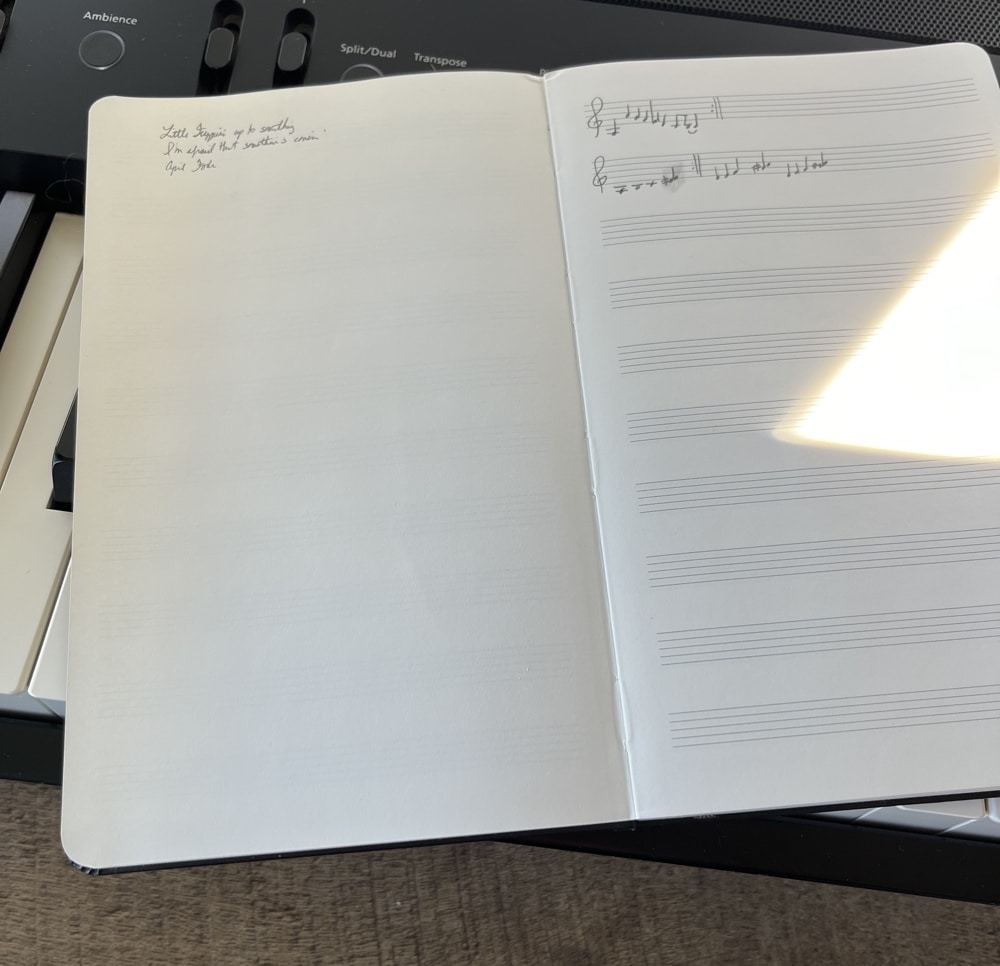
After panicking for a bit, I scrambled and started trying to reconstruct at least the story and what rhymes or words I could remember. In the end, I don’t know how many lyrics I lost, or how many were replaced with something better. But I’m proud of the final version and am so grateful it wasn’t any worse than it was! I’ll definitely not be using that method for storing lyrics the next time!
More Edits to Come
They say a good piece of writing is never done. But there’s definitely got to be a stopping point. Thankfully, I can still change things about each piece up until the last minute. So next time, I’ll tell you about some last minute melody changes that came about as part of the editing process.
Stay tuned!
Do you have any questions about composing the music, writing lyrics, or other things about composing? Let me know in the comments!
And sign up for the newsletter so you don’t miss updates and articles like this one!
Here are the two final pieces about which I journaled:




Thank you. I am loving hear your composing process! One of my students who has played some of the Little Fuzzie pieces says she wants to learn to play all of them. Thank you for your fun inspiring music that keeps kids motivated to play the piano.
I had just read Part 2 about the rhythm creation. This afternoon I started a student on April Fools’ Mischief. Just by reading the words she played the rhythm perfectly. Wendy, you’re a genius! This is also the student who is devoting an entire page in her brag book for all the Little Fuzzies Achievement Cards.
I love your pieces ! What program do you use to actually compose the music? I like to compose but not sure how to get it from my head to actual music. I can write it down but there has to be an easier way.
Thanks