
Smart Scales is such a unique resource that we wanted to take a moment to help you understand how to use it. We’ve received some wonderful questions in the past, so we thought a Q&A blog post featuring the author and composer, Diane Hidy, would be a great idea! If you have other Smart Scales questions that are not answered here, please put them in the comments below.
What is Smart Scales?
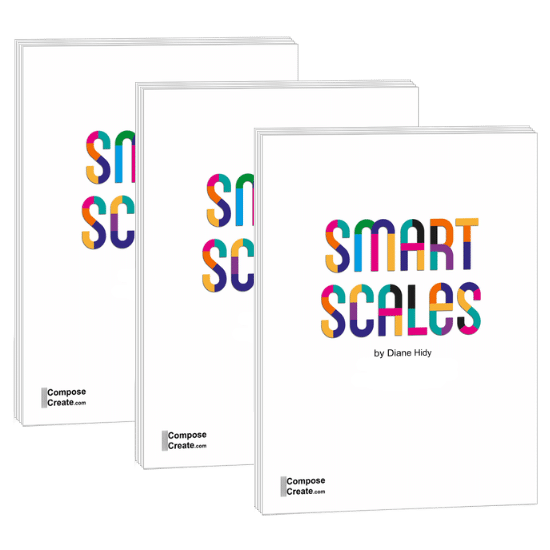
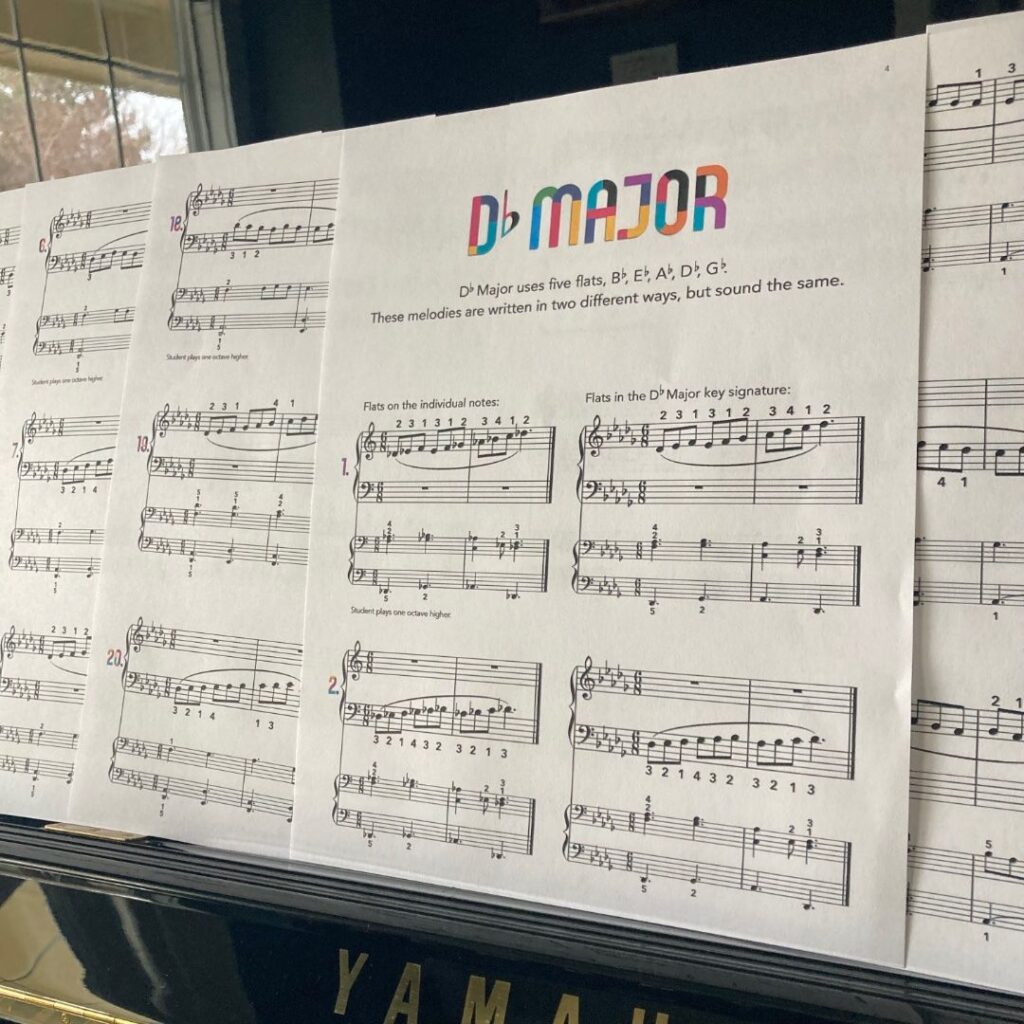
Smart Scales is a tool for helping students become comfortable and proficient playing in a given key. Smart Scales is a digital scale book that gets the unique feeling of each key under students’ hands. Each unit features a scale (for example, C Major), and has 14 four-measure musical melodies set in 6/8 time with a corresponding teacher duet. Each book comes with a foreword by the author and an attractive, easy-to-read design suitable for students of all ages.
It’s much more helpful than regular scale books because:
- It helps students become comfortable within each key and helps them NOT be afraid of playing in key signatures.
- It helps them “noodle” around the the scale and fingering crossings in the exact ways that music does, but scale practice does not!
- It encourages musicality and allows students to experience the key much as they would in a piece – one of Diane’s students even asked to play Smart Scales in a recital!
- Smart Scales teaches the scales of difficult keys organically and in a bite-sized way.
Smart Scales Questions Answered with Diane Hidy
Can you give us a quick summary of what Smart Scales is and what it does?
Smart Scales is a tool for helping students become comfortable and proficient playing in a given key. Though this is traditionally done by playing rote scales, I found that teaching those scales was A) not much fun and B) not very effective. I created Smart Scales to give students lots of opportunities to get comfortable with the specific melodic patterns one finds in each key.
Which editions of Smart Scales are available now?
The editions available now are White Key Majors, Black Key Majors, and White Key Minors. (Editor’s Note: There is only one product page for all of the editions. Just make your selection in the dropdown menu!)
How do you use Smart Scales in your teaching?
I use Smart Scales with every single young student in my studio. Instead of assigning rote scales, I assign a few Smart Scales each week. Some students can do as much as an entire key per week, while others need to move more slowly. No matter what pace, the students are usually quite comfortable with playing in a key after completing the entire unit.
Why isn’t practicing scales the traditional way good enough?
First of all, it’s pretty dull. It’s not much fun for the students and it’s definitely not interesting for teachers. The absolutely best thing about Smart Scales is the the way it magically transforms the teacher from corrector to collaborator. The experience of playing through a unit of Smart Scales is a pleasant one for both teachers and their students!
Why does this exist? How is this different than what I already have?
There’s nothing like Smart Scales out there; it’s about learning to play music, not to play scales. The idea that only practicing scales would make someone comfortable with the curves and delightful way melodies move up and down and all around doesn’t really make much sense.
Should I forego teaching scales the traditional way and ONLY do Smart Scales?
That depends on whether or not you feel Smart Scales have provided enough actually scale practice. For students who will be taking any sort of exam, they’ll still need to learn their scales in whatever style they will be tested on. For many students who don’t do exams, they may be able to forgo that work.
Are the melodies in each key identical?
Though many of the melodies share characteristics, they are unique to each key. Because each key has its own unique feel, I made the melodies exploit those special traits and avoid doing things that were uncomfortable.
How many do you normally assign at once?
This varies with the student. For some students, handling several similar keys (D, A and E major) at one time is a doable task. For some students, even one key is a lot to handle. For the majority of my students I usually assign one key at a time. In a perfect world I try to assign a new key just before they need to use it in an upcoming piece.
Why are there no dynamics? What dynamic should students play these?
There aren’t any dynamics because the page would be too crowded if there were hairpins and dynamic marks. In general, one should encourage students to play musically and shape the phrase by doing a gentle crescendo in ascending passages, and a simple diminuendo when the line falls. Teachers can cue their students to do this by playing the accompaniment in a way that encourages musicality. It’s natural and easy to do. Students will almost always respond to the teacher’s shaped phrases.
How long before the black key set will be out? I want to make books out of the minors too.
I am working hard to have the black key minors finished as soon as possible. I’m taking a break from working on them, in fact, to answer your Smart Scales question. Each version has its own flavor and intricacies 🙂
We’re curious about how the raised 6th and 7th isn’t always observed in some minor key excerpts. It’s not always observed in the duet part either, but I’m assuming that’s so it fits harmonically with the student part.
The idea behind the Smart Scales is to develop fluency in each key, not to learn a specific form of the scale. In general, I use the Melodic Minor form of the minor scale because I’m writing melodies, but even in the most conventional melodies sometimes the melodic scale will create a harmonic problem. It’s fascinating how many times this happens. I went ahead and used these tricky moments because they happen all the time in actual music, so it’s important to be able to handle them when they come up.
In the majors, why did you choose to not include F# and C#? I know they get the same notes with Gb and Db, but I feel they still need experience with each different key signature.
Another fascinating Smart Scales question. I used the easiest key signatures because it makes learning the patterns slightly easier. For students who are advanced enough to handle a piece in F sharp major, (The Schumann Romance No. 2 in F sharp Major Op. 28 comes to mind) they will already have learned the patterns in an easier-to-read key. Overall, there are very few pieces written in those difficult keys. (I LOVE that Schumann but find it ridiculously hard to read and decode and therefore almost never teach it!)
Leave your questions below, or click on the images below to learn even more!
What a great Q&A! If you have more Smart Scales questions, please share them with us. And to learn more about Smart Scales, each product page below contains a wealth of information, including a 17 minute webinar video excerpt from Diane!
-
 $49.99


I (and my students) are LOVING Smart Scales. I have been assigning usually one key at a time, either all at once, or over 2-3 weeks, depending on the student. The majority of my students are adults, so they grasp the concept but of course their fingers need just as much time to master scale fingerings and key signature as anyone else. I’m curious if you usually hand a student an entire set at a time, ie Major White Keys, or one key at a time. I do print these out on my home printer, so can individualize as needed. I tend to teach in circle of 5ths order, which means we hit a black key scale before we run out of white keys, but the question is the same. A big chunk at once, or one key at a time?
Oh, another question. You mentioned in one of the webinars that you might be available for a Zoom session on SS. Can you say more about that, and about the cost? I’m wondering if our local MTNA group might be interested.
Hi Kathy,
I tend to assign my students one Smart Scale key at a time. If you want, you can give them a bit of a second key as a preview. Some adults, however, really like to see the entire puzzle before they dive in — kind of like when you make a jigsaw puzzle, they like to know that it will contain 1,000 pieces and the pieces will interlock. One of my adult students surprised me by learning almost ALL the white key minors in one week because he found them so fascinating. There isn’t a right or wrong way to do it, you’ll need to assess the student’s needs for knowing what they’re in for versus their tendency to become overwhelmed by too much information.
I am happy to do a ZOOM session for any local group or organization. Please contact me privately for the fees involved, but it is much less than getting me there in person!