
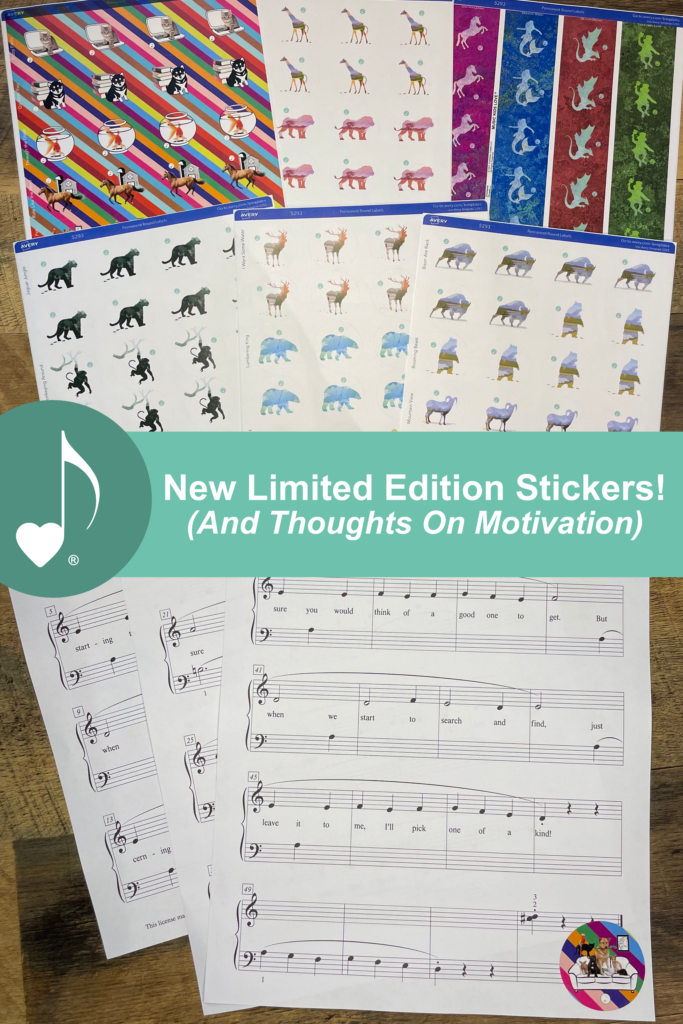
If you’re a teacher who uses stickers in lessons, you are going to love this big announcement!
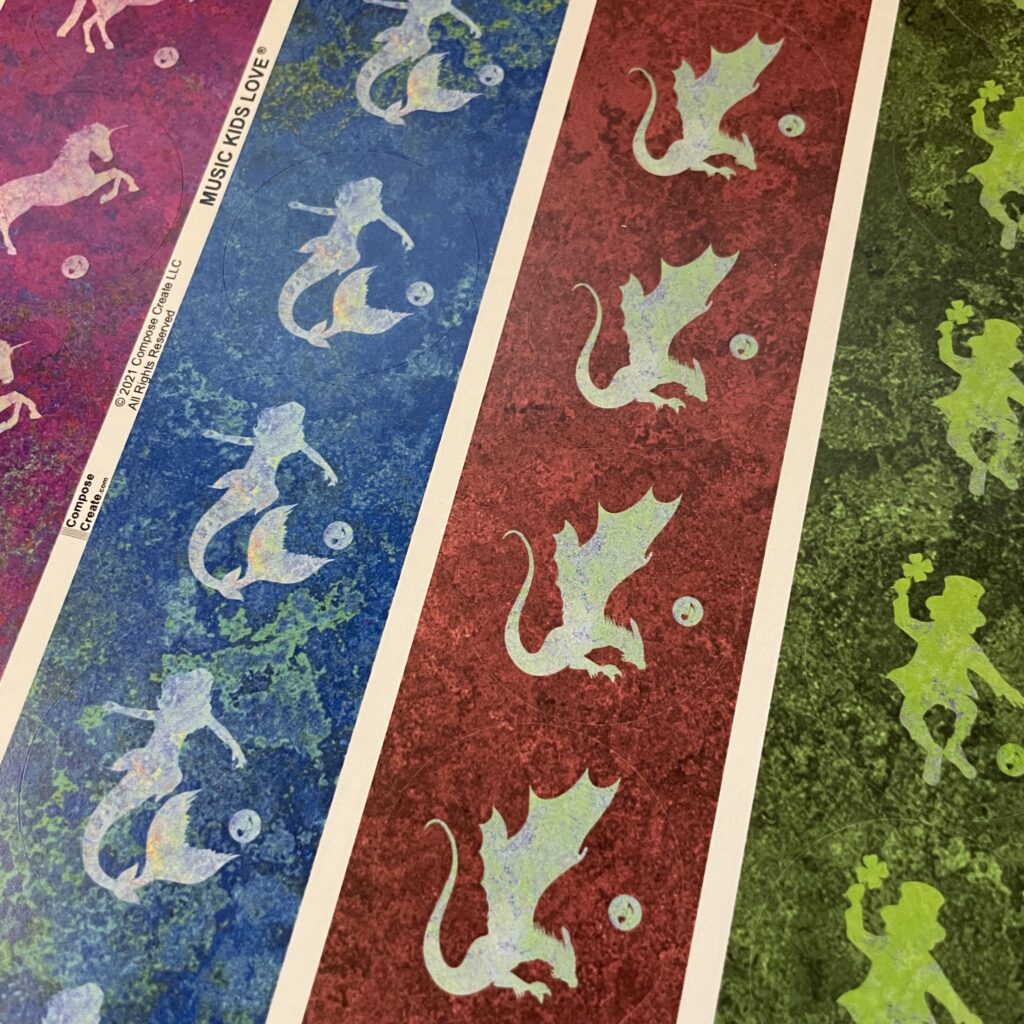
We now have limited edition stickers!
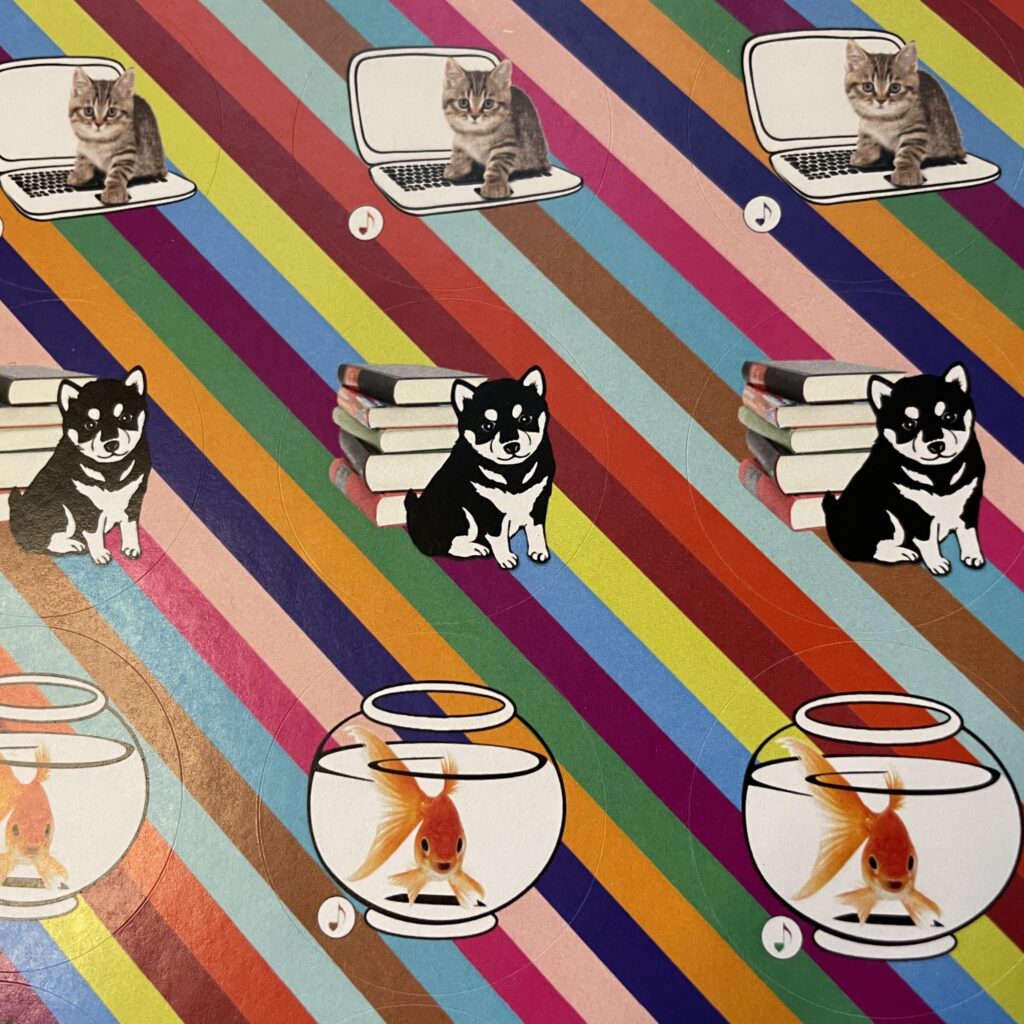
These are especially fun if you have any of the Mythical Creatures Set, Pet Shop Pieces, African Adventure, Canadian Adventure, American Adventure, or Amazon Adventure Bundles! There are only a certain number of printed stickers for each set, and we’re not sure if we’ll do another printing, so be sure to get them here before they run out!
Stickers can be a bit of a weird topic for piano teachers. Some love them, and others feel it isn’t right to reward students extrinsically.
This post isn’t meant to tell you what to do. Every studio, teacher, and student is different! But it does raise interesting questions about the types and effects of motivation.
Intrinsic vs. Extrinsic Motivation
The first thing to understand when thinking about whether students should be motivated by something like stickers is to understand the two types of motivation. Intrinsic motivation is what happens when a child makes their own choice, and experiences fulfillment because of choosing, performing, or enjoying the activity. The activity is what generates the motivation, so it tends to be self-sustaining.
Extrinsic motivation is something you do in order to please someone else, to fulfill someone else’s wishes, or to get a reward for what you have done. It’s more difficult to sustain because it’s happening due to an outside force.
As teachers, intrinsic motivation is clearly the end goal we want for our students. We want them to practice and learn pieces because they love to play! But is asking our younger students to be motivated purely because they love the music or love to play something we as adults even fully do?
Does Pure Intrinsic Motivation Happen Very Often?
If I am being honest, there is very little I do out of purely intrinsic motivation! Extrinsic motivation is any outside party or force that is enforcing an activity on you. I don’t particularly enjoy getting gas in my car (especially in the PNW right now when it’s 105+ degrees!). There is nothing intrinsically motivating about it – I don’t enjoy the activity, and receive no fulfillment whatsoever from it. But the external motivator of not wanting to walk the rest of the way home keeps me doing it. Sometimes extrinsic motivation isn’t bad, it’s just necessary.

Preparing for a recital is an example of how this may play out with our students. During no other time of year do my students practice the way they do before a recital. The extrinsic motivator of playing in front of an audience sure does kick their practice into high gear! This is extrinsic motivation yes, but it’s the kind of motivation students will experience throughout their entire lives, and something that’s good for them!
Mixing It Up
Life is full of activities that include intrinsic and extrinsic motivation. Let’s take a look cooking: baking bread because I enjoy the process is intrinsic. Baking because my family needs to eat is extrinsic. But these both motivate me at the same time! Just like most things in life, motivation often isn’t strictly black and white.
There are times that my intrinsically motivated students need extrinsic motivation because they’re going through a bit of a slump. And sometimes my mainly extrinsically motivated students become intrinsically motivated when they play a piece they love.
Kids are going to have the same complex mixes of motivation that we have, and that is normal. Kids are still building up experiences that give them a real basis and understanding of intrinsic motivation. They may need external motivation to get them to a point where they understand how an activity is intrinsically motivating!
The Overjustification Effect
Perhaps you are wondering though about the Overjustification Effect. It’s the finding that offering external rewards for something that’s already intrinsically rewarding can lead to a reduction in the intrinsic motivation. But there are two caveats to this. First, the person has to already find the activity intrinsically motivating. Second, if the extrinsic reinforcement is given in addition to the need to perform well, the behavior isn’t likely to succumb the Overjustification Effect.
For example: if you put a sticker on a recital piece, that sticker isn’t likely to diminish their intrinsic motivation. Why? Because playing the recital for people and getting their approval is really what is contingent on their learning the piece. The sticker reinforces the practicing behavior, but the student’s success is actually dependent on how well they perform.
If this makes you worry that your sticker policy will undermine whether your students become intrinsically motivated pianists, that’s not the case! It’s good to have this knowledge, but your regular interactions with students are far more important than whether or not you use stickers. If you know a student doesn’t really like stickers, don’t use them! Is it just to get them through a slump? Give it a go! Do you think they’d love stickers that match the music they’re learning? Then use them as a fun extra incentive!
Why Do Kids Love Stickers? What If It’s Not About Motivation?
As an incredibly type A, list-making, organization-loving individual, I thrive off of sticker charts and to do lists. I have a planner and sticker sheets with little appointment icons, and I happily cross items off my to-do list. I have even been known to add something to my list that is already done just so I can cross it off. While I’m not advocating for this (probably unhealthy) behavior, I’m saying that there is a real feeling of accomplishment that comes when you have a physical way to mark something as “done”.
I’ve started asking my students who love stickers why they love them – and the overwhelming response is that my sticker-loving kiddos loves them because it shows them that they accomplished something! Of course, this will vary from studio to studio, but students usually don’t learn the piece because they want a sticker. What motivates them is being able to look at the piece and think, “Yep, that one is complete!”
When a student feels they’re not making progress, it can bring encouragement to look and say, “I learned a lot! Look at how many songs I completed!”. A piece with a sticker means they worked hard and accomplished what they set out to do. I love to play the piano, but only because of years of practice.
Our students are in the stage of years of practice so they learn to love the piano. A little extra encouragement tells them they are headed in the right direction. Which leads us to…
New Limited Edition Stickers!
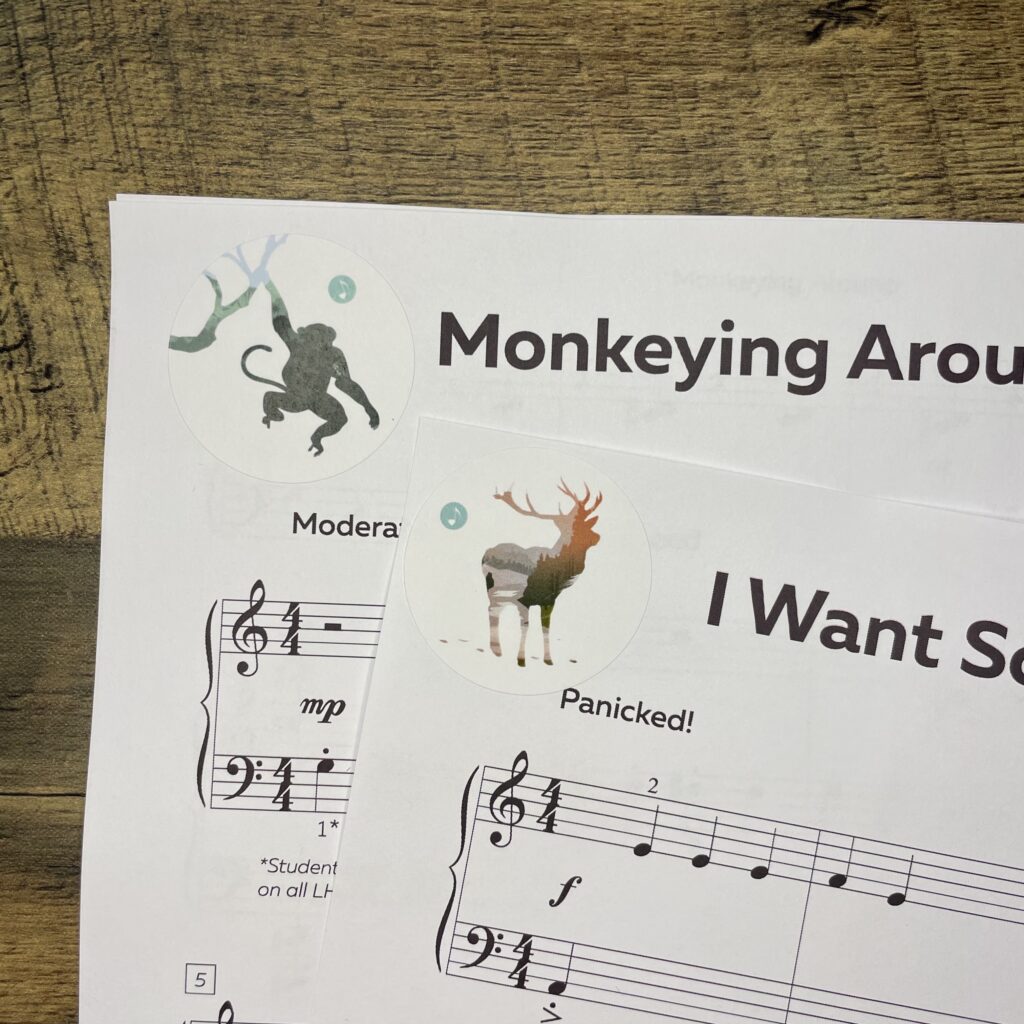
I think even students who don’t typically like stickers will love these! They’re bold, vibrant, and are available for the Mythical Creatures, Pet Shop, American Adventure, African Adventure, Canadian Adventure, and Amazon Adventure Series. They are not the usual, predictable stickers that come in dollar store packs, and would work wonderfully for older students. They’re almost 2 inches diameter (exact dimensions are 1 2/3″)! Plus, who wouldn’t want a sticker that matches the piece they’re learning?
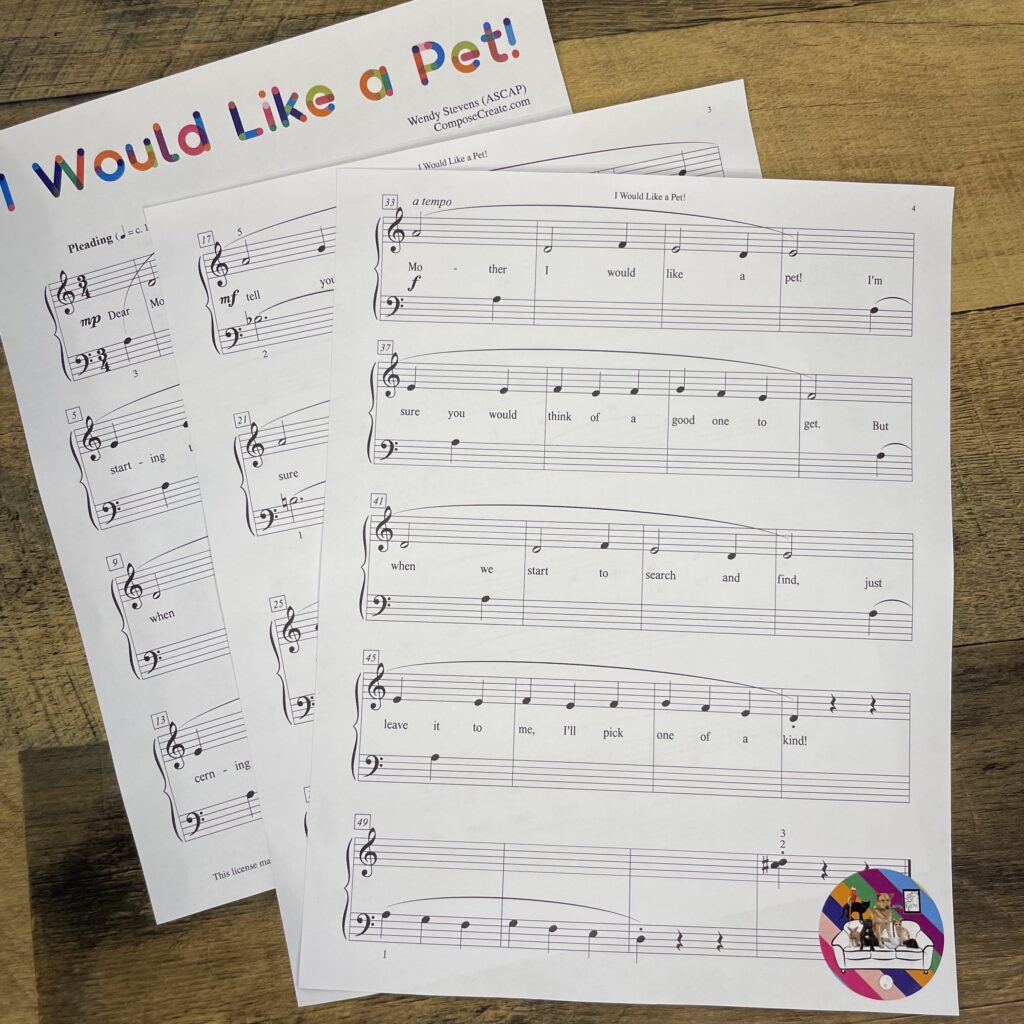
If you don’t use stickers on pieces, their large size and bold colors would be perfect for charts for studio-wide incentives, or as prizes. You could also have a student start one of these series and use the stickers to keep track of the pieces in the series they’ve learned. It’s amazing what having a visual can do to get kids excited about finishing something!
Do you have any tips for using stickers in the studio? Are there other ComposeCreate sticker sets you’d like to see in the future? Let us know in the comments!
Want to Get These Articles In Your Email?
If you are a piano teacher and want to know when articles like these get published, please join our email newsletter! We send out weekly newsletters with articles, new music notifications, free webinar opportunities and free teaching resources! We’d love to have you a part of the ComposeCreate community.

