
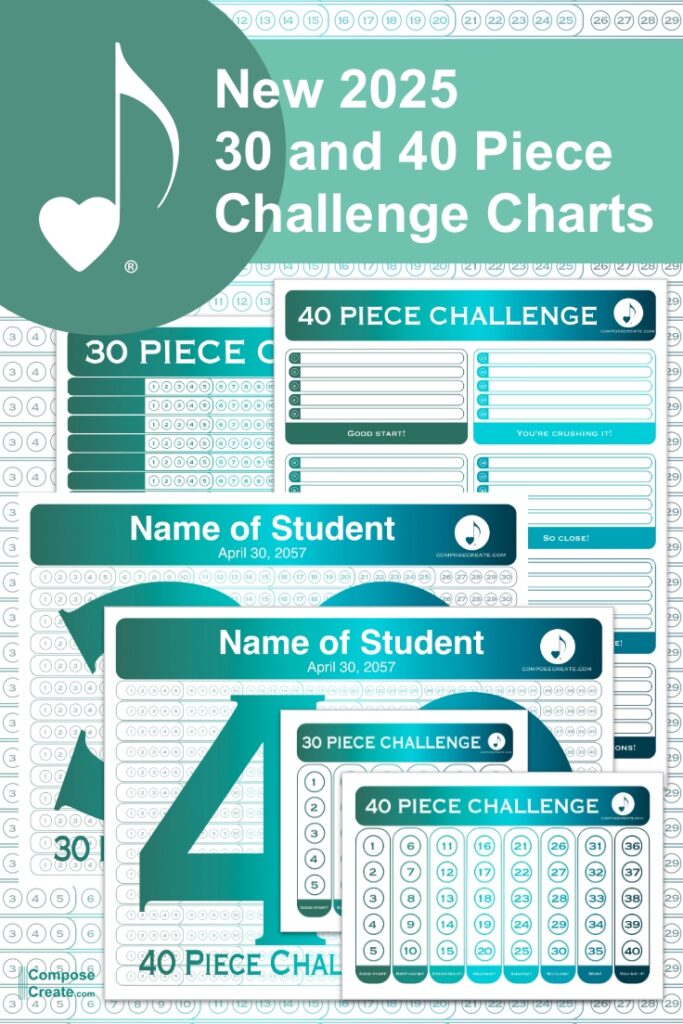
Over the years, teachers have asked, “Do 30 Piece Challenge pieces need to be memorized?” and “How polished do they need to be?” So I wanted to weigh in on these things at the same time we’re releasing our new blue-green 30 and 40 piece challenge charts!
The new design of the 30 and 40 Piece Challenge Charts that we launched last year was a huge hit! Teachers have loved the new look and the added features that you can read about here.
This year’s Challenge Charts showcase the calming and vibrant colors of the sea, with beautiful turquoise, teal, and aqua colors. Anyone who loves blue or water will love this year’s colorway!
How Does the Challenge Work?
The 30 or 40 Piece Challenge is a year-long program that challenges students to learn more music. As you know, when students play through and learn more music at different levels, they become better sight-readers. And the more exposed they are to different kinds of music, the more fluent they are in different styles, different notation, formats, and other such things. The 30 or 40 Piece Challenge was created by Elissa Milne, and we have created these charts over the years with her blessing.
The 30 and 40 Piece Challenge works best when you remember that three levels of music must be included:
- Challenging pieces. It is paramount that students continue to be challenged through their longer and more difficult pieces. Recital pieces, festival pieces, and competition pieces that students memorize all fall into this category. And it’s important that students continue to study challenging music. Here’s an article from over a decade ago where I talk about the importance of this!
- Pieces at the students’ level. These would be like method book pieces.
- Pieces below the students’ level (never be afraid of using this music). Learning to polish even easier pieces helps students pay attention to detail and may even free them to work more on these details since the music is less difficult.
Do They Need to be Polished? Perfected? Memorized?
Over the years, teachers have asked how polished or perfected a piece needs to be to count. And while that’s always going to be somewhat relative, I think it’s important that students polish the piece to where it’s “beautiful and accurate.” This means, students can have that performance bobble that happens to all of us. But it needs to be “beautiful and accurate” to count. So a piece that’s abandoned because it’s too challenging or a piece that has notable incorrect rhythms should not count. “Beautiful and accurate” has some leeway to it, which can account for different teachers’ preferences.
Some teachers wonder if challenge pieces need to be memorized. And while I say, “most of them don’t,” I would qualify it with a quick reminder that we should be having our students memorize some of their pieces so that they can perform them “on the fly” or at performances and festivals. Most teachers have their students memorize several pieces during the year for recitals and festivals, and it’s important to remember that the discipline of memorizing skill that we should teach! Having your students memorize several of the shorter pieces in their Challenge is a great way to give them music that can play on the fly at a friend’s house or when someone asks them to play during the holidays!
What’s Included in the 2025 Newly Designed Challenge Charts?
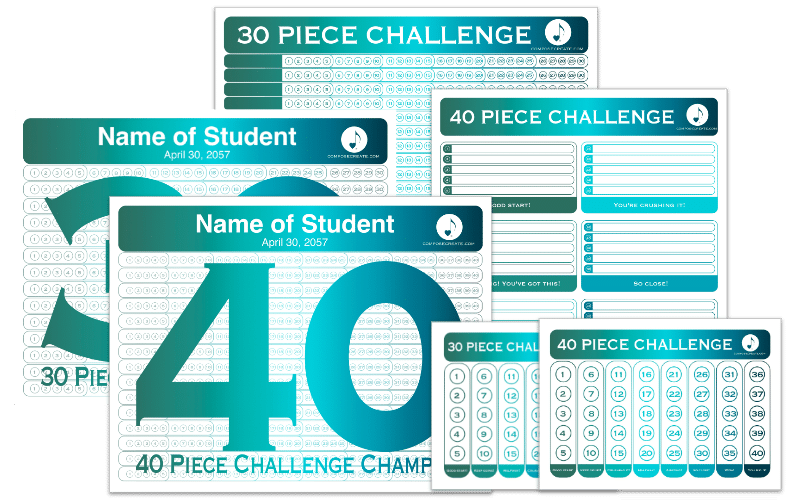
When you download this year’s charts, you receive a beautiful set of files with PDF documents that you can freely edit for an automatically polished look, for both the 30 and 40 Piece Challenge options! When you type in your students’ names on your teacher chart, or the student certificates, you’ll see an easily legible font that matches the design. Easy as pie.
A fantastic feature is that repetitive information, like the “Teacher’s Name” and “Date” blanks on the Student Certificate, automatically appears on each page, while individualized info like student names, don’t (you have to type those in individually). Here’s a list of what exactly you receive when you download the charts:
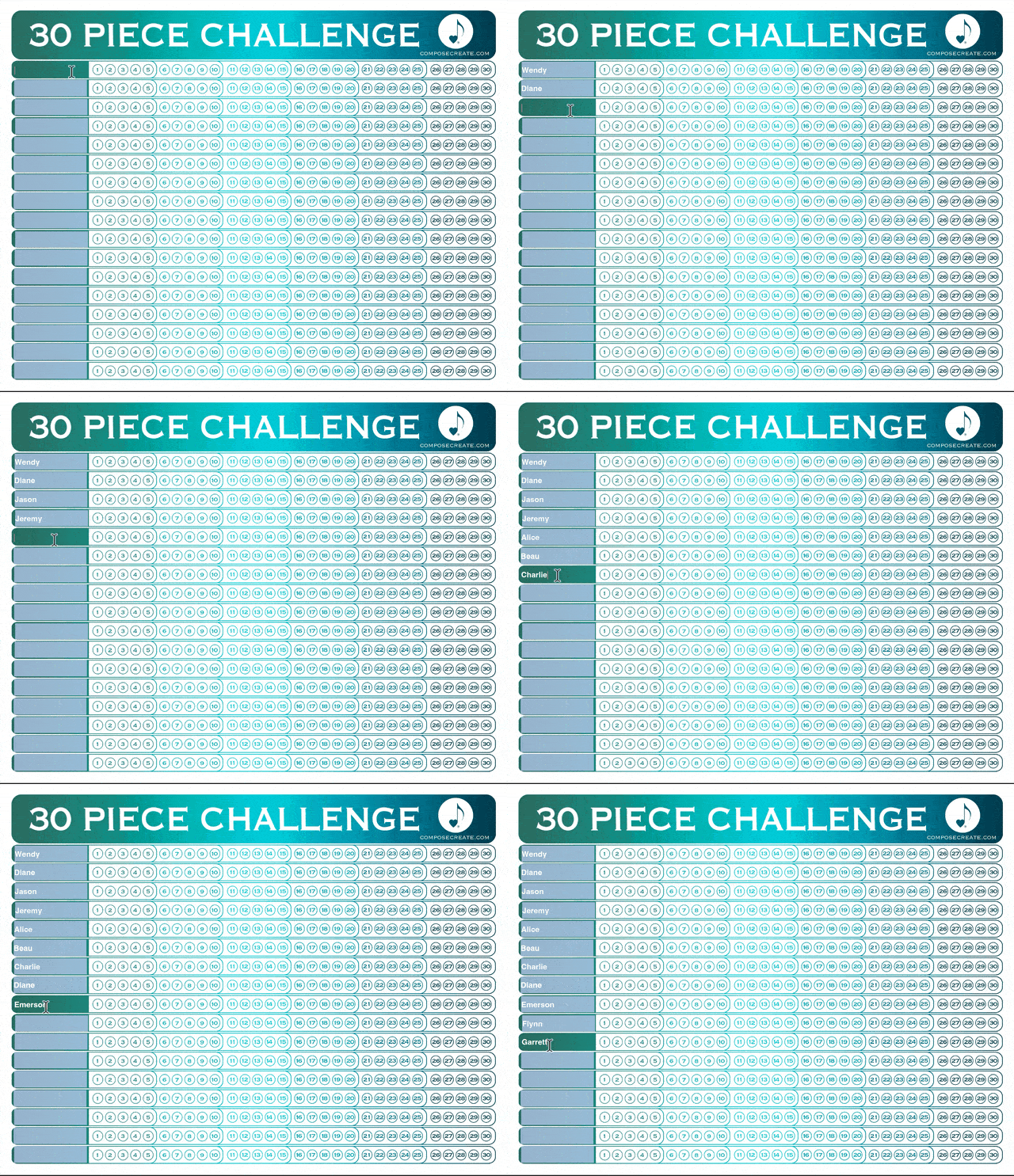
- The Teacher Wall Chart: Write (or type in Adobe Reader) students’ names on this chart to display in your studio. Some teachers have a large version made at a print shop. Students will mark their progress with stickers or other markers when they start a piece.
- The Stamp Card: The stamp card is a fun way for students to see their progress “at a glance”! They’re small, and fit perfectly on the outside of the binder. It can also be used for extra incentives, for example, “cashing in” the completed stamp card at local businesses or for a prize. You can use rubber stamps, hole punches, or small stickers to mark progress. The bubbles on this card, when printed on standard 8 1/2 x11” printer paper, are about the size of a hole punch diameter.
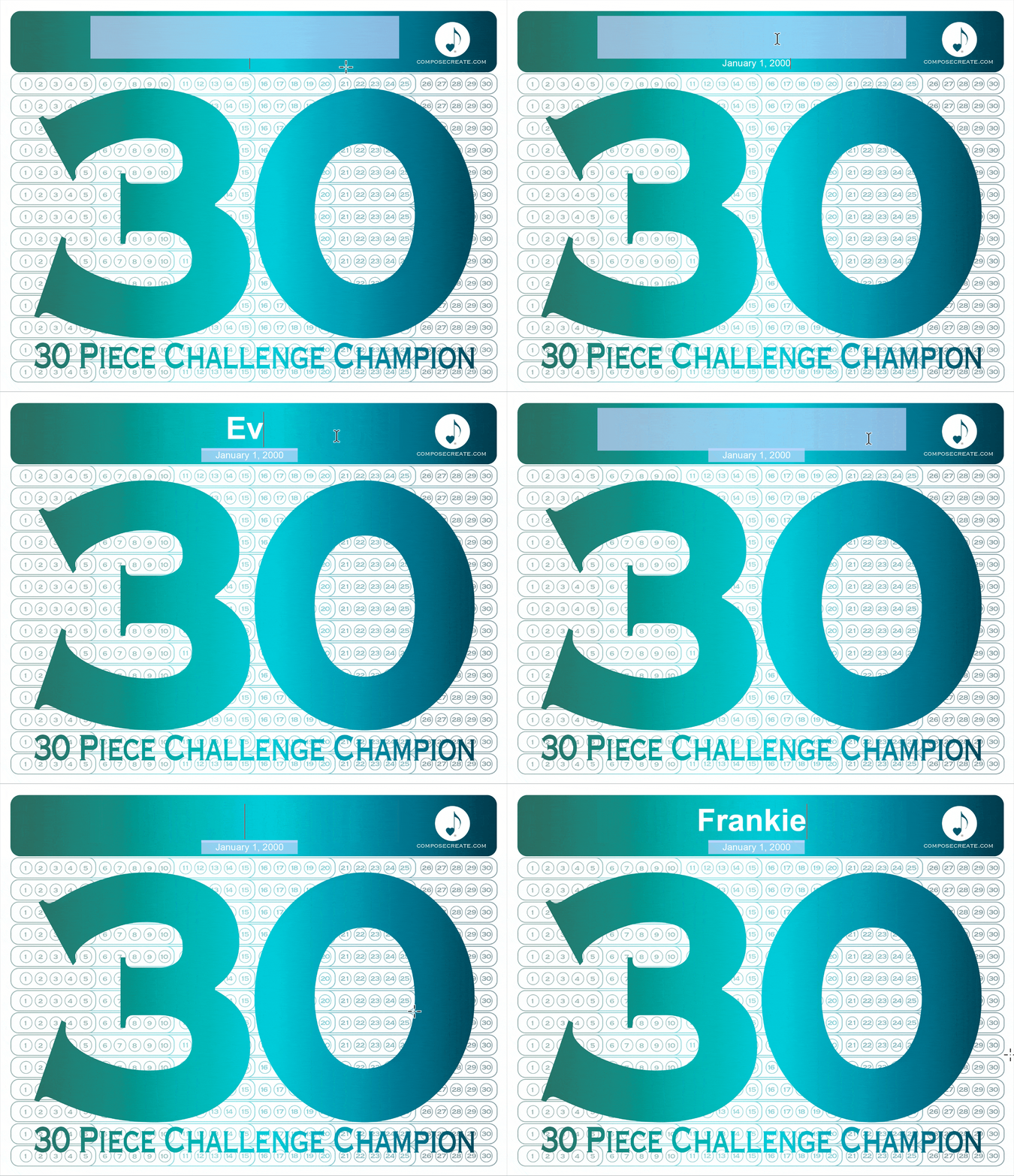
- The Student Certificate: 30 and 40 Piece Champions will be so proud to see their names typed in and printed out when they accomplish their goal! You can give this completed certificate to your students, or display them on your studio wall!
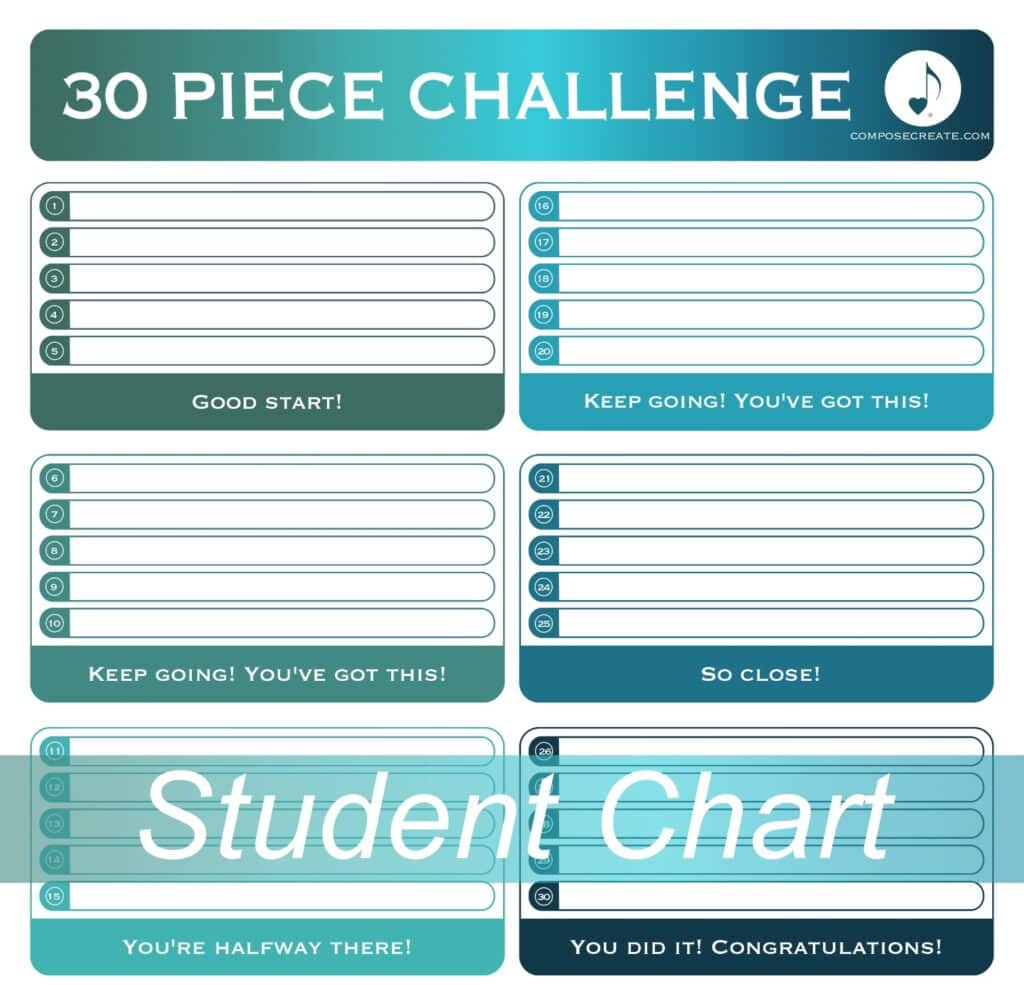
- The Student Chart: This is the chart where students write the titles of their pieces, and it’s kept in the student’s binder. Elissa Milne and Wendy suggest writing in a piece title when it’s begun rather than finished, and whether or not challenge pieces need to be memorized is up to you!
What are the Improvements You Made Last Year?
Here is a summary of the improvements we made to the charts last year that have been continued through this year’s charts!
- Teacher Wall Chart: 2024 gave us the idea to group pieces in sets of 5. This propels students onwards, motivating them to keep going until they reach the end of the challenge! And of course, using Adobe Reader, you can easily type in your students’ names in the document, for a polished look. Keep the teacher chart on the wall to foster healthy competition in your studio!
- The Student Chart: Feeling progress as you go is a powerful motivational tool to stay the course. As of last year, pieces are grouped in sets of 5, with motivational slogans along the way to keep morale high as they approach and pass all the mini-milestones! The student chart looks beautiful printed on cardstock for each student’s binder. They’ll be proud when they see it in their piano binder, and the extra dose of motivational encouragement is a wonderful conversation starter in your lessons!
- The Stamp Card: The stamp card was also created as of last year, and while it’s optional, we think it’s a great way for students to see their progress at a glance! The design of the stamp card forms vertical columns with 5 pieces grouped together – once more, inviting students to work hard to complete each mini-goal of 5 pieces on their way to the final 30 or 40! Some teachers find local businesses to donate goodies to students. Then they reward their students at the completion of a certain number of stamps or stickers on their card!
- The Student Certificate: Every student certificate calls the finishing student a “Champion”! We love every opportunity to champion students, so why not celebrate their success? It’s easily editable in Adobe Reader, and looks beautiful displayed on the wall or framed. Don’t forget that you can type in the date and your name, which automatically appear on every page (wow!), but student’s names are still entered individually.
How to Start the 30 or 40 Piece Challenge
Starting the Challenge is quite easy! Download and become familiar with the documents, using the handy guides at the start of each PDF. With a printer, cardstock or paper, a hole punch or special stickers (optional), you’re good to go. And if you have more questions, read this post with the Most Common Questions about the 30 and 40 Piece Challenge!
What is the core ingredient to succeeding in the Challenge?
I mention this above, but it’s worth repeating since it’s SO important to the challenge! We have to give students 3 kinds of music:
- Music at their level:
This would be what we normally have in a lesson. - Music above their level:
These are typically pieces that take many weeks to learn, like a recital piece - Music below their level:
This is the music that most teachers forget to include, but it’s some of the most important. The reason is that students always need to feel like they are making progress. When we give them music that is always above where they are, it’s hard for them to feel that. So giving them music below their level helps them not only gain confidence, but it also and especially helps them to become more fluent sight readers and get exposed to different styles of music. You’ll find that especially your older and more advanced students need this and are MUCH happier and more motivated when they have at least one piece below their level. - Shorter music:
This is related to pieces below your students’ levels. It doesn’t apply to early level students as much, since all their music is short, but students late elementary and beyond especially need pieces they can master in 1-2 weeks! They’ll feel so motivated as they move more quickly through the challenge.
What music is perfect for the Challenge?
You already have the perfect music for about half of the challenge – just the normal music that you use in lessons! Short Sheets® are also the perfect solution for giving shorter pieces of music below your students’ levels. Short Sheets® and Tune Up Tunes® are sets of 3 one-page pieces that are pedagogically sound, but short, making them easy for students to learn and complete in 1-2 weeks. Our beautiful collection of Short Sheets® is available for students from pre-reading to late intermediate level! Peruse the entire collection here.
What are your thoughts about the newly designed Challenge Charts?
We would love to know how you feel as you approach using these materials. Feel free to comment below to discuss any of these questions!
- Have you done the 30 and 40 Piece Challenge in your studio?
- What do you think about the new colors?
- Is this your first time using the charts?
- Does your studio have any fun traditions for the Challenge?
