
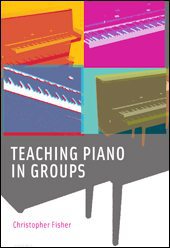
 Christopher Fisher, Assistant Professor of Piano at Ohio University), has just written a new book called Teaching Piano in Groups. This book is a one-stop compendium of information related to all aspects of group piano teaching. I am sure it will become required reading for piano pedagogy students across the country. In addition, this book looks like it should be on the reading list of every independent music teacher.
I knew Chris in college and was impressed by his diligence, commitment to excellence, and kindness to those around him. I am certain that his book is a well researched and extremely well written resource for group teaching. Chris has graciously agreed to do an online interview with me for this blog.
 Tell us about your inspiration to write this book.
During my undergraduate and graduate studies, I became enamored by the transformative power of the group piano learning environment. It was during this time that I started teaching piano in a variety of group formats, and began witnessing astonishing growth and development in my student’s overall level of pianistic achievement. As a result of these experiences, I have taught in some form of group ever since and have become a passionate advocate for group piano teaching.
As they saying goes, “Two heads are better than one.” I believe strongly in the potential of group learning environments and I acknowledge that many others share this conviction. Still I realize there are those who have never given group teaching a chance. Because of this, I set out to write a guidebook for the novice piano teacher with the hope of inspiring interest in the instructional format while creating a reference resource for the experienced teacher. Furthermore, as a university pedagogy professor, I was motivated by the fact that there existed no text that was explicitly devoted to group piano pedagogy. Teaching Piano in Groups was designed to fill this void.
What kind of book is this?
Initially, I set out to write a comprehensive narrative on all aspect of group piano teaching. While admittedly I’ve found such an attempt to be futile, I have made a concerted effort to cover the most salient features of group piano teaching and the intricacies involved in teaching children and adolescents, university music majors and adult hobby students.
Who might find this book helpful?
It is my hope that all piano teachers will find the book helpful in some manner, from the novice pedagogy student to the veteran group piano teacher. I trust the book will serve as both a handbook and reference resource, and will inspire renewed interest in and thoughtful dialogue regarding teaching piano in groups.
What is your favorite part or topic in the book?
Since I’ve been deeply invested in this project for the last three and a half years, I must confess that it is quite a challenge to identify a favorite part or topic. With that said, I have a great interest in the application of cooperative learning theory to group piano teaching and continue to dedicate a significant amount of time to research in this realm I am also a connossieur and collector of effective group instructional strategies and activities, so it was a particular thrill to present a few of my favorite in this book.
Are there any misconceptions about group teaching that you would like to address?
There remain teachers who regard group piano teaching as an inferior mode of instruction and, who as a result of this opinion, categorically avoid teaching in groups. As one who is wholly convinced of the potential of the group piano learning environment and its manifold benefits, I feel committed to demonstrating how group teaching, when conducted properly, can both positively and profoundly transform student learning experiences.
Piano teachers often cite the disparity of student levels in groups as a primary concern. I see this as an enormous advantage rather than an insurmountable hindrance. Because of this dynamic environment involving students with unique abilities and individual differences, students stand to learn something from one another and can contribute something meaningful to the group. Further, the potential for groups to motivate students to higher levels of achievement is an undeniable benefit. Indeed, the efficacy of group piano teaching is proven and the list of its merits is expansive. It is my hope that all piano teachers will experiment with group teaching in some fashion if they have not already. And if they have in the past and have failed, I encourage them to try again and to seriously consider ways to enhance the effectiveness of their approach. As is the case with any venture, anything worth doing is worth the effort necessary to carry it out with success. To be sure, group piano teaching is an investment that has the potential to pay huge dividends.
What is your favorite part of teaching in groups?
I am always invigorated by the dynamic exchange of information and knowledge among students in the group piano learning environment. It is thrilling to witness students being actively involved in their own and each other’s learning. This sense of ownership and accountability propels students to higher levels of learning and skill refinement. And beyond this, teaching in groups is simply great fun!
Chris’s book may be purchased from Amazon or Oxford University Press.


I can’t wait to get this book! As a former classroom music teacher I love groups, but I have always felt I needed some help in how to teach piano in a group. This book sounds like it will address my concerns.