
This article, written by Dr. Christopher Fisher, begins our series of posts on group piano teaching. Christopher discusses this week and next week the advantages and techniques of working with groups as their primary method of instruction. You can also read about teaching groups as a supplement to private lessons. Be sure to sign up for the newsletter if you aren’t getting these kinds of articles in your email!
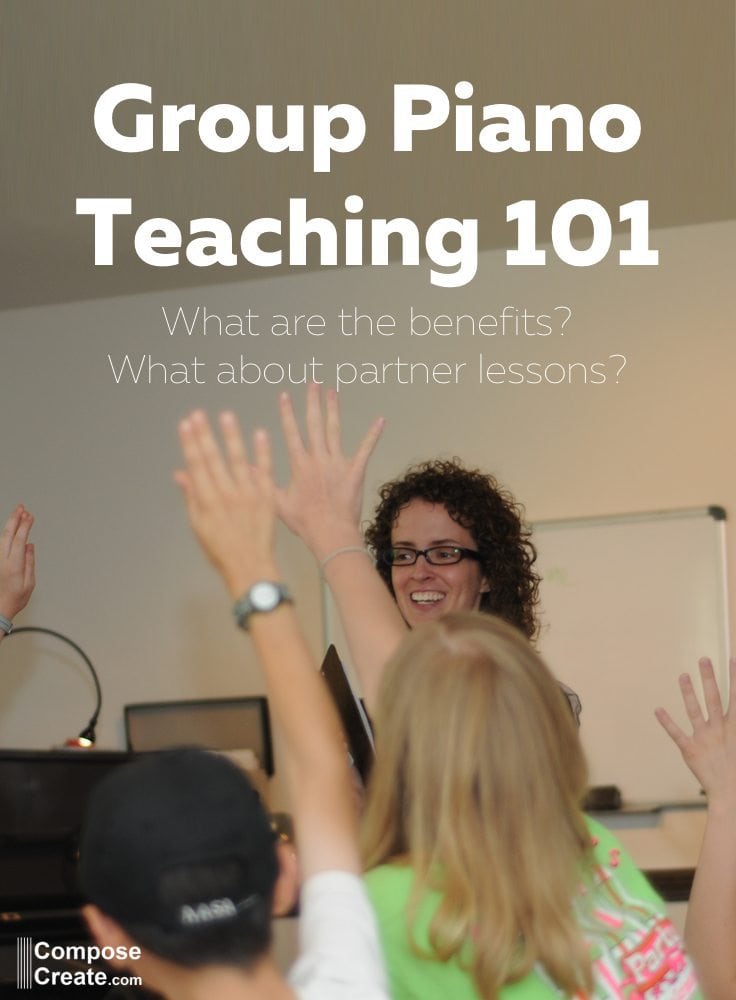
Group Piano Teaching 101
by Christopher Fisher
Educators have long acknowledged the power of teaching and learning in group environments, and it is thrilling to see this excitement spilling over into the realm of piano pedagogy. To be sure, when conducted properly, this type of instruction has the potential to positively transform and strengthen our students’ learning experiences. Among the many benefits of group piano instruction are the following:
- Exposes students to a wide variety of repertoire
- Provides limitless performance opportunities for students
- Develops performance confidence and poise
- Encourages the development of critical listening and problem-solving skills
- Is a dynamic and motivational learning environment that can challenge students to higher levels of preparation and commitment
- Is an excellent format for teaching functional musicianship skills
- Facilitates the study of ensemble literature (i.e. duets, duos, multiple piano ensembles, etc.)
- Is a prime environment for the study of piano technique
- Encourages the development of a strong rhythmic sense*
This above list only scratches the surface of the many merits of studying piano in groups. So how does one get started? For the first time group piano teacher, it is wise to start small. I encourage teachers to select one age group or level and design a group for these students. As such, one can focus his energy on the intricacies of facilitating learning in one age group or level at a time. Pre-school or average-age beginner groups are often a great place to begin. Not only is this an effective and efficient way to begin music study, it is also tremendously motivating. Plus, it provides an excellent way to build one’s studio enrollment base.
Another excellent introductory format is the partner or dyad lesson. In this format, each student experiences a fifteen-minute private lesson and an overlapping thirty minute group lesson all in one hour of teaching time. In addition to the obvious benefit of the built-in duet partner, students experience a sense of accountability to weekly preparation and practice.
With regard to materials, I have found that most methods can be easily tailored for use in group instruction. Here at Ohio University, we use the Piano Safari method for our piano preparatory program. In this program offered through the Athens Community Music School, students attend an hour lesson each week. Broad technical and musical concepts are taught and reinforced during the group session and are then refined in partners/dyads. Partner lessons are taught by our undergraduate and graduate intern instructors. This exciting program offers young beginners the joys and benefits of both large and small group instruction.
It is my hope that you will experiment with group teaching in some fashion if you have not done so already. And if you have in the past and the results were not what you expected, I encourage you to give it another shot and to consider ways to enhance effectiveness. As is the case with any venture, anything worth doing is worth the effort necessary to carry it out with success. To be sure, group piano teaching is an investment that has the potential to pay huge dividends.**
___________________________ 
Dr. Christopher Fisher is Associate Professor of Piano at the Ohio University School of Music where he serves as Chair of the Keyboard Division. He is the author of Teaching Piano in Groups (Oxford University Press) He and his wife Katherine are co-authoring the revised and expanded edition of Piano Duet Repertoire (Indiana University Press). www.chrisfisherpiano.com You may also visit his site devoted to Group Piano Teaching.
*Fisher, Christopher, Teaching Piano in Groups (New York: Oxford University Press, 2010), 7-11.
**The material from this article is derived from Teaching Piano in Groups (Oxford University Press, 2010) and other writings and lectures by the author. All rights reserved.


I look forward to the rest of this serious because I’ve been wanting to start group lessons, but just didn’t know where and how to get started!
I have recently been given the opportunity to design, build and implement an eight-station piano lab at my high school. Although I’ve taught studio piano for 30-some years, group piano is a new adventure for me, especially with all the technology involved. This lab will be used to reinforce the vocal and instrumental arts classes in theory, composition, and music technology, as well as to teach basic piano skills. I am looking forward to learning all I can from this and other websites as my students and I break new ground this year. Hopefully an old dog can learn a few new tricks after all!
I started teaching group four years ago using the Mayron Cole Method and have really enjoyed it. The children have learned as well or better than when I taught private and retention is better. The Mayron Cole Method not only provides curriculum, but also lots of guidance for teachers who are new to teaching group.
This is a link to their site: http://www.mcpiano.com