
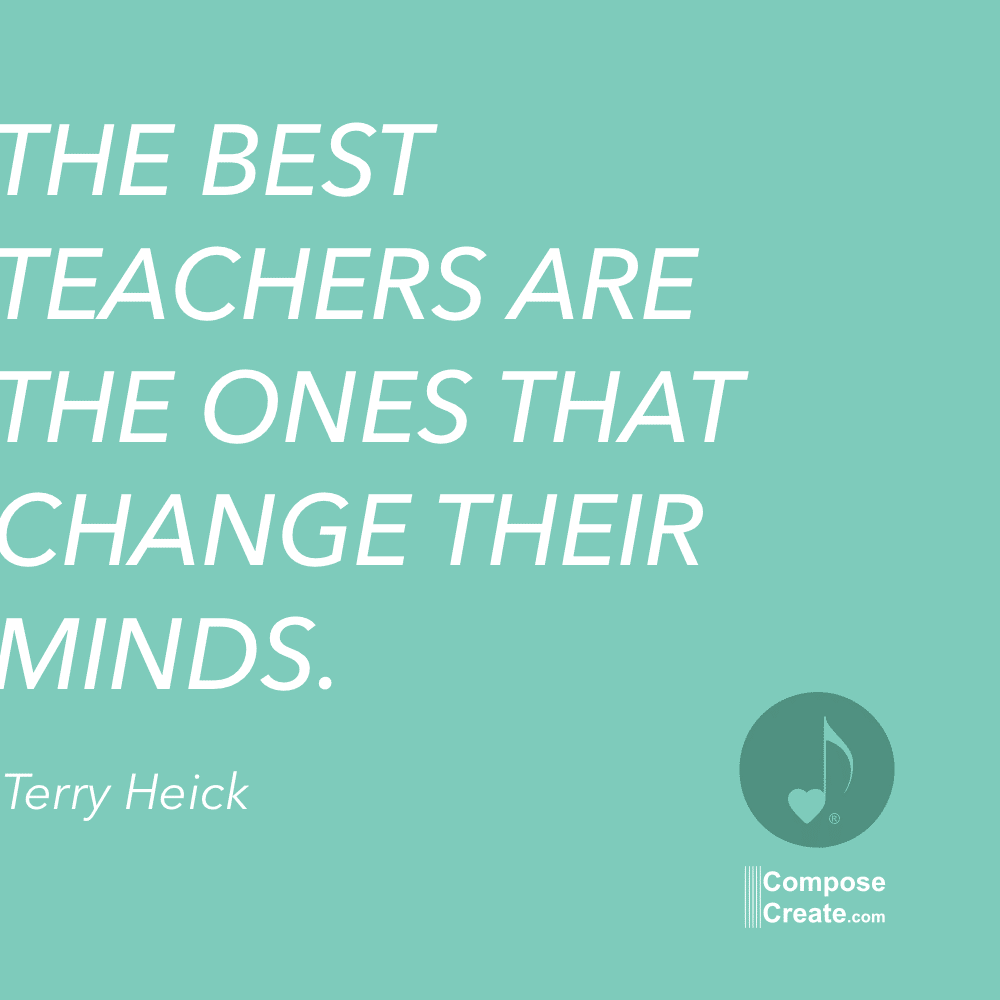
We often get stuck thinking that there is a “right” way to teach certain concepts. But I think to be a good teacher is to admit that there is not a “right” way, but better ways and even multiple ways to teach something. And even when we find a better way, those better ways can still be built on as we age and mature.
So it’s good for me to be reminded (both in teaching AND in parenting) that it’s okay to change my mind. It’s okay to let the student’s needs change how I approach an issue. It’s okay to let the student’s personality affect my music choices. It’s okay to let their strengths and weaknesses force me to explore other ways of teaching (or parenting) – even ones I’ve turned my nose up at in the past!
The other day I saw a quote that stopped me in my tracks, especially as a person who loves stability:
I used to think that things were real, and change was something that happened to them over time. Now I think that change is real, and things are events that happen over time. Change is the constant and things come and go, appear and disappear.
Brian McLaren
Change is constant in our world. So to be willing to change our mind is only to adapt to reality. It’s not a sign of weakness, or lack of conviction. It’s a sign that we’re learning ourselves. We’re growing. We’re admitting that we’re human and not perfect.
Of course, you know that it’s healthy to have boundaries in teaching and it’s healthy to know what techniques of teaching would be inappropriate no matter what the situation (like yelling or unkind words, etc.). So I’m not saying that we become doormats for our students to dictate what they want in our time with them. Of course not! We are the professional, so we have a responsibility to plan a good and healthy path for learning for each of our students.
But when I see a willingness to change and adapt in teachers, I see teachers that better connect with both their students, their parents, and all of humanity! And when I see it in my parenting, I notice a much better relationship with my kids.
That’s what I want and I hope I’m willing to change my mind about changing my mind in order to help this happen! 😀
What do you think? Please let me know in the comments below.
And if you enjoy mulling over encouraging or challenging thoughts, we share one every week on our Instagram channel. So you can follow us on IG.


In my studio I have many children with special needs and change is absolutely vital when teaching them. I am constantly re-evaluating my approach for teaching and feel it has not only helped my children with special needs but also my “conventional” students.
In my college education classes (a long time ago) we were taught four different learning styles, so I’ve always tried to have more than one to teach a concept. Some kids don’t get baseball talk, some don’t get dance talk. Along the way I’ve always enjoyed when kids themselves find a new way!
We’re not the only ones teaching!
I also have seen the need to change my approach with certain students, whether they are especially gifted and need a different curriculum to match their particular strengths, or they are not grasping certain fundamentals or techniques and need a little more creativity on my part. There is a certain piano curriculum that I, for the most part, dislike; but over the past couple years, that curriculum has actually helped a couple of my students whose minds seem to be wired for it. It is exciting to see different methods finally “click” with individual students.
I could not agree more! We, as teachers, need to be willing to adjust our methods based on the individual student. That old saying, “One size fits all,” does not apply to encouraging our students in their unique gifts and needs. Yes, sometimes we must adhere to certain boundaries, in order to give the student our very best instruction. But being willing to flex our approach, often inspires our students in their own musical journeys!
So true! I started teaching the landmark more method of note reading to my beginners, eschewing tthe FACE / Every Good … whatever… method I was taught to read music. I wanted to teach differently to how I was taught in every aspect. But have realised that, you know what, even I found the landmark method unclear and have gone back to teaching the way I was taught the notes. It’s been refreshing to go through this mindset of thinking, I tried that, but I’m going to do it this way instead!
You have changed my paradigm and that is the most exciting and fun aspect of life! Flipping my world!
I completely agree. Assuming that we had a thoughtful, purposeful approach the 1st time, if that isn’t working, we can definitely try different ways. But, try to change things like fingering very early on in the learning process, because it is very hard to change later on and the orginal way can come back to haunt you in performances. Our brains/muscles like to remember how we learned something the first time.
I am now completing my 47th year of teaching. I certainly don’t teach the way I did when I first began. So much has changed since I taught that first student in 1976. I couldn’t have imagined teaching online, YouTube, Wikipedia, computers or this smart phone I am using to write to you. Change is inevitable, and over the years I have changed lots of things. The one constant is caring for my students and finding the best way that works for them. I am grateful for all the methods and materials that didn’t exist in 1976 and I look forward to see what is the next new thing that will be available to help my students learn and love music even more.
I absolutely believe in change – never ending change! I have a few things that I always teach the same way, but I absolutely love trying new things and having a toolbox of different strategies to draw from. Here is a benefit of being willing to change that I discovered this year. I had a 13 year old boy who was considering quitting. I knew from working with him that he loved classical pieces and that he was interested in playing keyboard for his youth group at church. I suggested to his mom that we could focus solely on the classics and spend more time learning the strategies for lead sheet playing and now her son is back on board and motivated to start the year with new goals!
A teacher has to adapt to the learning style of each student, more like custom design their lessons. One method book is not the answer to learning successfully. When I see that this student doesn’t do well with this book, I will make a change by selecting a different method book that works for a particular student. If this student is making progress, I will switch to another method book to let this student be able to adapt to some changes, but not all everything is new, there are still something old that he/she can spot in the new method book. That is good changes.
No 2 people have the same fingerprint. The differences in people require adaptation while remaining true to the goals we establish for them. Teaching is a skill, not just a career. The challenge and joy is developing the skill & seeing the positive results!
Yes, yes, and yes!! Now in my 30th year of teaching, I’m still learning this kind of flexibility! No way does only one angle, one perspective, one “method” work for all students! I’m learning to not stick to one way when I see it’s not working… I need to move on and teach the same concept a different way. This improves my teaching, often forcing me to think and plan “outside of my box”.
When I decided as a high schooler that I wanted to be a piano teacher, my teacher (who was in her late 70s at the time) told me that continuing education was of utmost importance – the doctors and lawyers do it, and so should piano teachers – and that when we stop changing, that’s when we die. That has been one of the best pieces of teaching advice that I have ever received (the other being that as teachers, we shouldn’t exist to make carbon copies of ourselves). Just recently, I had a teenager who was not practicing a Diabelli sonatina, but learning other assigned pieces more quickly than I expected. He told me that he liked the sonatina, but his actions said otherwise. We dialogued about it and I learned that he was struggling to remember all of the articulations and motions needed to achieve the articulations & dynamics. He was so focused on executing the motions correctly that he had no working memory left to hear what he was playing. Imagine not being able to hear or enjoy what you are playing! No wonder he was procrastinating! So together, we explored other ways of practicing that would allow him to enjoy the learning process, involving improvisation. Now I have a new teaching strategy to use with other students!
What a wonderful topic. Over my 53 years of teaching, I have always been very eclectic in my approach to teaching. “ Tailor the task to fit the student.” This slogan came to me in the 1970s when I earned my Orff Schulwerk certification which has been the basis of my teaching ever since. ComposeCreate provides the ideal imaginative mix of musical material to engender the joy of music for all students. The musical elements of rhythm, harmony, melody, form, and timbre are always present in magically fun ways!
Chiming in a bit late here, but wanted to nod along with everyone else. When I started teaching, 45+ years ago, it was pretty much by the seat of my pants. I had a degree in music but no pedagogy training — there were only a handful of places even offering ‘pedagogy’ and in fact I had never even heard the term before. Launched by an unexpected need for income and informed only by a few brief suggestions from my college piano professor (who, it turned out, had studied with Frances Clark and Louise Goss at the New School for Music Study, which of course I had never heard of, either), I found a few students and dived in. Two things saved me. One, my own insatiable curiosity about music and love of learning, and two, my finding our small local MTNA affiliate group and joining it. I learned so much from these colleagues. In those days, in our small town far from any universities or big cities, we were on our own to self-educate and teach each other. I attended conferences — state and national — and took workshops, subscribed to piano magazines, read books on teaching, and, eventually, took two pedagogy programs over the years. I had to constantly learn and adapt, and was fortunate that my second pedagogy class at a ‘nearby’ (160 miles away) university was taught by a brilliant teacher who demonstrated ‘change! adapt! work with what the students bring you!’ in our observed lessons and class work. Of course the advent of email, the internet, and downloadable music (yay, Wendy!) has opened everything up for us independent music teachers all over the world. Change doesn’t always come easily, and isn’t always welcomed to begin with, but let’s face it: it is inevitable, it is part of living life as a human, and doing our best to go with it is the only way to survive. A tip of the hat to all of you, my colleagues, and fellow learners!