

When you assign a new scale at a lesson do you ever feel like you’re already dreading listening to it the following week? I used to feel that way every time I taught scales.
I was teaching them just the way I’d learned them: one key at a time, one hand at a time, first five-finger patterns, then one octave scales. We would slowly put the hands together until some kind of fluidity, or more often tolerability, developed. Unfortunately, it often went badly.
First, the one octave scales were musically unsatisfying and demotivating because they lacked musical context. There were no engaging rhythms or appealing harmonies so it was no wonder neither of us were enjoying ourselves!
Second, each key has its own feel and flavor. Unfortunately, conveying this information to students wasn’t happening by drilling them one octave at a time.
I grew determined to find a better way to teach scales. I challenged myself to come up with a new recipe for developing comfort in every key.
How This More Comfortable Way Emerged
I knew there needed to be a step between five-finger patterns and scales. The jump to one-octave scales was too big and awkward. This was part of why I kept avoiding teaching those first scales.
I wanted to foster a love for the way a given key feels under one’s fingers. Ab major should feel cuddly and cozy. D Major should feel bright and business-like. Traditionally taught, they just feel identically precarious. (Not to mention the role the metronome can play in increasing anxiety for students who are already overwhelmed with auditory stimulation.) I wanted a way to let my students experience the joy of the contours of scales under their fingers.
I experimented with different time signatures until I discovered that 6/8 made the most charming melodies. Its built-in lilt encouraged the students to play with movement, while the length of the dotted quarters offered them brief moments to pause and refocus. I have never seen another way to teach scales that takes advantage of this delightful time signature.
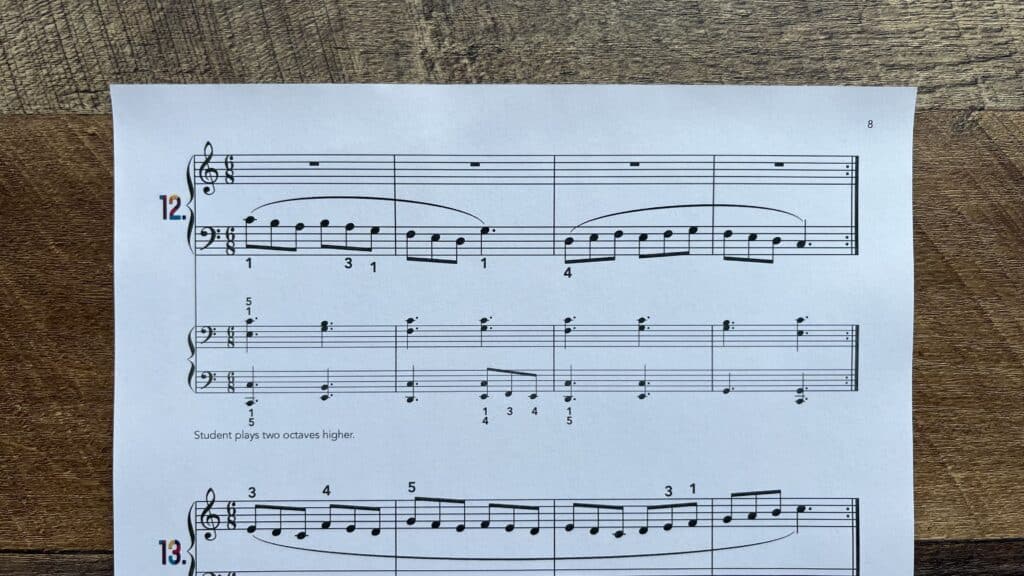
The eighth note passages that occur naturally in 6/8 time are also much easier to read than the same passage would be written in quarter notes. The beams help students easily follow the direction the notes are moving.
These subtle differences matter.
Smart Scales – The Better Way to Teach Scales
Before long I found myself assigning these new “Smart Scales” to almost every one of my students. And they loved them! Eight-year-old kids, Stanford Engineering Professors, teenagers, every last one of my students played them with a grin on their face. I suspected some of the reasons were because:
- They liked how they felt and sounded.
- They savored the sensation and curve of each scale.
- They appreciated the unique and incremental challenges presented in the melodies.
- The new Smart Scales were the complete opposite experience of scales served in “eight notes up and eight notes down” portions.

The variety of different melodies in the same key enabled my students to stay in the same key long enough to actually achieve fluency. They developed facility and comfort with common musical shapes in each new key. Even better, I could keep them in that particular key longer while providing novelty. The novelty was what kept them engaged, and what made it fun for both of us. (I suspect their families at home also enjoyed the delightful melodies instead of one octave scales.)
The teacher accompaniments, printed directly below each melody, provided both the rhythmic and harmonic context which traditional scales lacked. They subtly provided rhythmic support, encouragement and feedback. I became a collaborator instead of a corrector. My students would usually hear for themselves when something was wrong. Some of my students were fortunate to have a parent who plays well enough to play the teacher part, so that made the Smart Scales all the more fun to practice and play at home.
Examples of Why It’s Better
Here’s an example from the key of A Major:
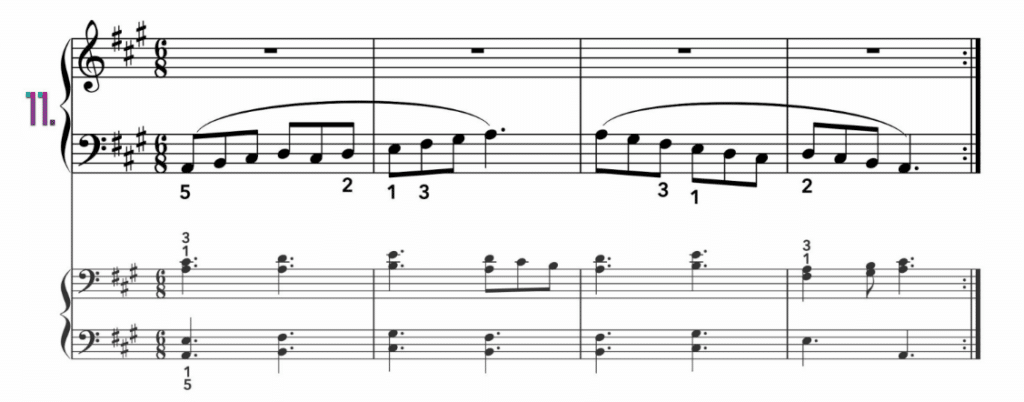
Notice how the extra curves in the melody make it more fun to cross the third finger over? The rhythm helps cross the thumb under on the way back down?
Here’s an example from the key of B Major.
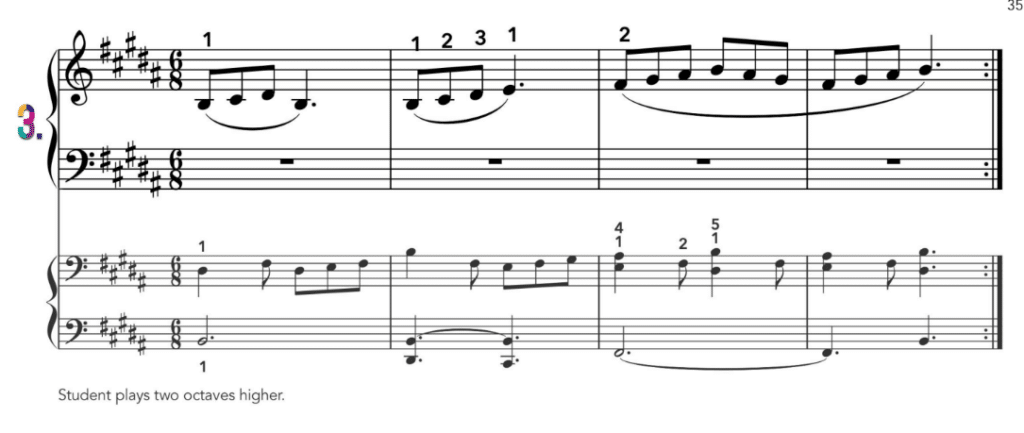
Notice the thumb; first we don’t cross, then we do! The rhythm makes it sound like real music and not just an exercise.
Normal Kids Need Scaffolded Steps
Let’s face it. Most of us teach normal kids who need scaffolding steps for learning the basics.
Each key begins with an example written without a key signature (the sharps or flats are written directly on the notes.) The same example is then shown with a key signature. It’s a wonderful opportunity to teach or review key signatures and exactly what they do.
In the process of playing this series of beautiful, interesting, idiomatic melodies, my students are learning their scales. And they’re actually enjoying the process!
Smart Scales Available:
All the Smart Scales PDF books for white key major, white key minor, black key major, and black key minor will be coming in due time. Here is what have available currently:
-
 $49.99


I love how the rhythm reinforces the fingering pattern for B major! I thought you might like this short free piece I composed to help my students remember the pattern of major scales that includes simple primary chords in the left hand. I intentionally began with the simple Pentascale, played Tonic to match the words and chose a rhythm that makes the pattern more memorable. It’s available for free on this blogpost. It’s like a side dish 😉 for the smart scales that students could be challenged to transpose to other keys to help strengthen chord skills too. https://heidispianonotes.blogspot.com/2023/07/piano-one-octave-major-scales-song.html?m=1
I use Smart Scales with almost every lesson. The draw for me is the teacher accompaniment which is sublime. My students love the sounds of the scales with the harmonies.
I adore my white key Smart Scales!!
How do Igo about re-downloading this for the extra reference pages?
I’m loving the Smart Scales!!! I’m also wondering why you chose not to include F# and C#. I know they’re the same notes as Gb and Db, but I like to include the entire Circle of 5ths. (I also re-arrange mine to follow the Circle of 5ths pattern.)