
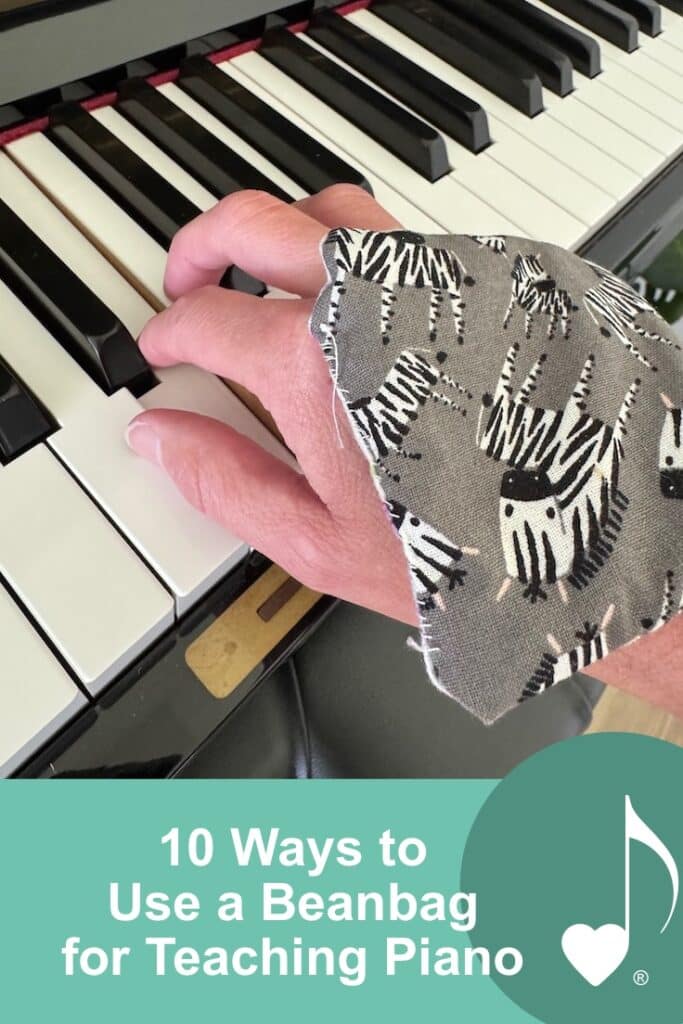
During the From Teacher to Superhero kick-off webinar this August, Wendy brought up how a beanbag can help your students learn voicing. In piano teaching, voicing is making the melody louder than the accompaniment. It’s a challenging technique because students have to learn how to execute different volume levels from each hand, or even different fingers! So placing a beanbag on the student’s hand that is supposed to play louder is a great tactile way to remind them which hand to project.
So after Wendy shared that during the webinar, one teacher asked, “What are other ways you could use a beanbag in a piano lesson?” and many teachers gave such great ideas that we wanted to showcase them in this blog post! Want to add to our top 10 list of ways to use a beanbag for teaching piano? Be sure to comment on this post and share your great ideas!
Drumroll, please: The results are in!
Of COURSE piano teachers come up with the best ideas for using a bean bag for teaching piano! Some teachers had duplicate ideas at the webinar, so we minimally edited responses to combine them. Here are the 10 ways to use a bean bag for teaching piano:
- Carol: Put the beanbag on their head to reinforce posture (and sit up straight!).
- Robin: Place a large staff on the floor and toss the beanbags as they identify notes.
- Zayley: Toss it to the beat.
- Emilily: Beanbag for practicing staccato!
- Amy: Toss onto a floor staff – extra points for landing on landmark lines/spaces!
- Diane: Put beanie babies or a beanbag on a student’s shoulders to keep them from scrunching up their shoulders.
- Kelli: Sink their fingers into the beanbag for firm finger joints.
- Angela: For a quick off-the-bench activity: Spread out music things, and the student tosses the beanbag on the correct answer.
- Pam: Play catch with young kids for coordination and finger strength.
- Wendy: To teach voicing, place the beanbag on their hand to give the student the tactile reminder that one hand should be heavier than the other. Mingling in Madrid is a great piece for using the beanbag to teach voicing, by the way!
Got any more ways to use a bean bag in piano?
You know what to do! Add to our list by commenting with your contribution down below. We hope these ideas and tips help you flourish! Please join us at all of our webinars so we can hear from you, too! The best way to know when webinars are coming is to join the ComposeCreate® email newsletter. We send out emails on a predictable schedule and only tell you about things designed to help you flourish as a piano music teacher.


As an ear training exercise, I give the student a bean bag, and they stand at a distance from the bucket rim = a cutout of the top three inches of a 5 gallon bucket. I play a familiar tune, and when I make a mistake in intervals, loudness or articulation, they throw the bean bag into the bucket rim. Kids love this game!
Lay out large quarter, half, dotted half notes on the floor in a line. Quarter note should be closest to the student, the others behind it. Students toss the beanbag at the notes and get points according to how many beats they landed on (quarter=1 pt, half = 2 pts, etc). Students should add their points as they go. Can play with one person, 2 people or teams. Player who reaches 25 pts first is the winner.
These are wonderful ideas! Thank you for sharing them.
I have two more ways I use beanbags. On a floor staff, especially if the student isn’t great at landing on a specific note, I’ll have them toss it and say “line” or “Space,” or name the note, or even just name the clef it landed in. I love Amy’s idea above of extra points if they end up on landmark lines and spaces! If I make them tally up their own points, they’ll pay more attention whether it’s a landmark or not.
The other idea: I have a wastebasket with netting around it to look like a basketball hoop, and we can have a variety of “wins” for which the reward is getting to toss the beanbag into that hoop. As many tries as it takes, or I move it closer after every three tosses.
Beanie baby stuffies work too! And the kids love having them ride their arms!