
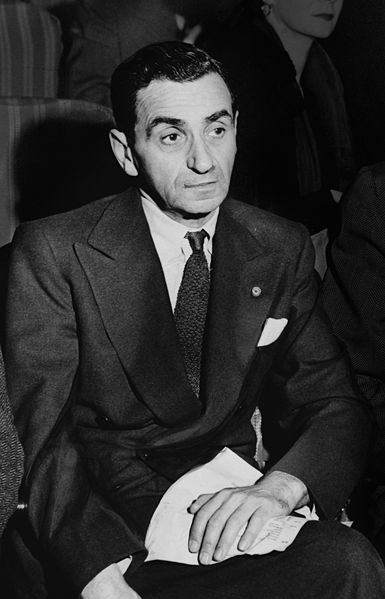
 I read a very interesting article in the Wall Street Journal about what makes Irving Berin’s “White Christmas” the “best selling record of all time.” Of course, this kind of thing should interest any composer who is the least bit concerned about connecting with people. As composers, we are always trying to find the best motive, the best hook, the best set of lyrics to invite the audience to listen and really experience a piece.
In short, there were a few points that the writer Roy Harris made about this piece that I had not stopped to think about before:
Berlin biographer Philip Furia believes the songwriter’s lack of formal musical training—he composed mostly on the black keys of F-sharp, often transposing songs with a specially modified piano—led to songs that “subtly depart from the most fundamental tenets of songwriting.” While others might have stressed “dreaming” and “Christmas,” for example, “Berlin deftly emphasizes the seemingly unimportant ‘I’m’ with a whole note, then races over the other syllables” before the next whole note, “white.”
In addition, he cites Rob Kapilow’s observation of how Berlin avoids the usual “bridge” in a song and heightens the impact of the melody by immediately repeating it (I’ve always found the half steps in the melody quite compelling myself). He specifically mentions the minor chords that occur on “listen” and “glisten” as “heartbreaking.”
The piece is not only the most popular Christmas piece of all time, but the the best selling single of all time. So, like it or not, it bears looking (or listening) into. Read the full article here. Listen to a podcast that includes earlier versions of the piece featuring an alternate intro/verse which is not heard today.

