
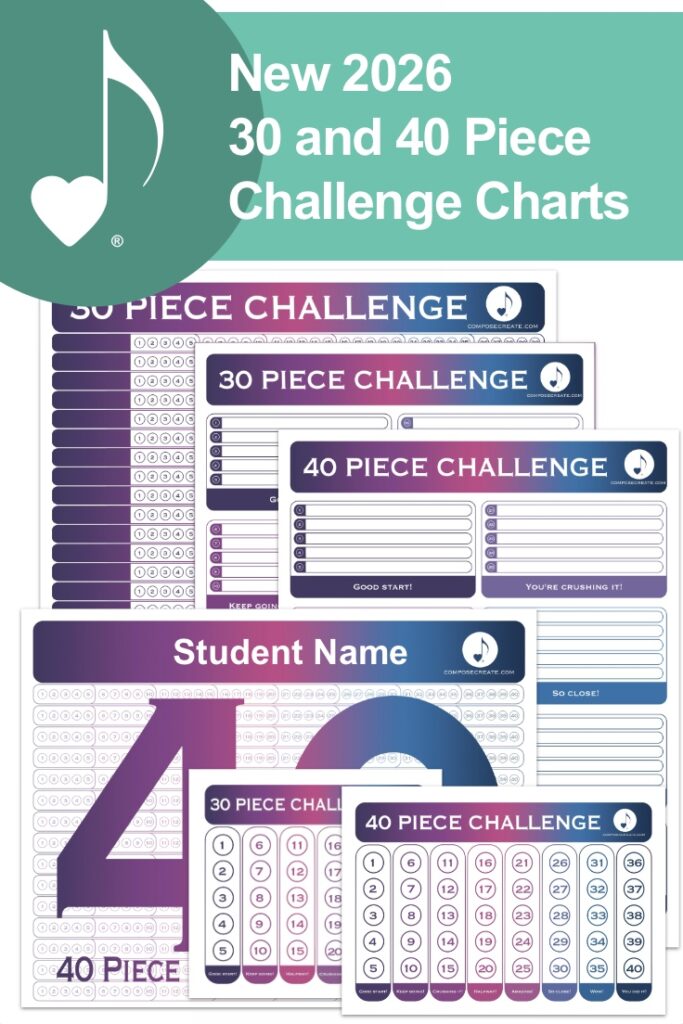
The new 2026 30 and 40 Piece Challenge Charts are here! This set is based on our new design that we unveiled a few years ago which improved on the original design to help students feel more motivated.
The color theme began with a lovely rainbow color palette for kids’ bedrooms that I found online. However, that design didn’t work since many of the colors were too light. But a good design has to start somewhere! So this morphed into an indigo, maroon, and blue theme that I love even more than the first palette. The white will pop remarkably over the deeper, rich colors in these 2026 30 and 40 Piece Challenge Charts.
What Do the 30 and 40 Piece Challenge Charts Cost?
Nothing! This is free resource from ComposeCreate. You just have to be subscribed to the newsletter in order to download it. Go ahead and click the download button if you aren’t a subscriber, and we’ll take care of re-subscribing you.
How Does the 30 and 40 Piece Challenge Work?
The 2026 30 and 40 Piece Challenge is a year-long program (I recommend not including summer, though you certainly can) that challenges students to learn more music accurately and play it more beautifully. It also keeps the student from getting “stuck” on longer pieces that they might be preparing for festivals, recitals or contests.
We know that when students play through and learn more music at different levels, they become better sight-readers. Their progress usually is faster and they become more rounded musicians when they are exposed to different different styles, different notation, formats, and other such things. The 30 or 40 Piece Challenge was created by Elissa Milne, and we have created these charts over the years with her blessing.
One of the most important things to remember about this challenge, though, is that you must include three different levels of music:
- Challenging pieces must be included. It is paramount that students continue to be challenged through their longer and more difficult pieces. Recital pieces, festival pieces, and competition pieces that students memorize all fall into this category. And it’s important that students continue to study challenging music. Here’s an article from over a decade ago where I talk about the importance of this!
- Pieces at the students’ level. These would be like method book pieces.
- Pieces below the students’ level (never be afraid of using this music). Learning to polish even easier pieces helps students pay attention to detail and may even free them to work more on these details since the music is less difficult.
I have more questions about the 30 Piece Challenge! Where do I go for answers?
Last year, we created a brand new article with all the most common questions about the 30 and 40 piece challenge charts and program. Please take a moment to read this in-depth article and you’ll find most of your questions answered there!
How Do I Use What’s Included in this Free Download?
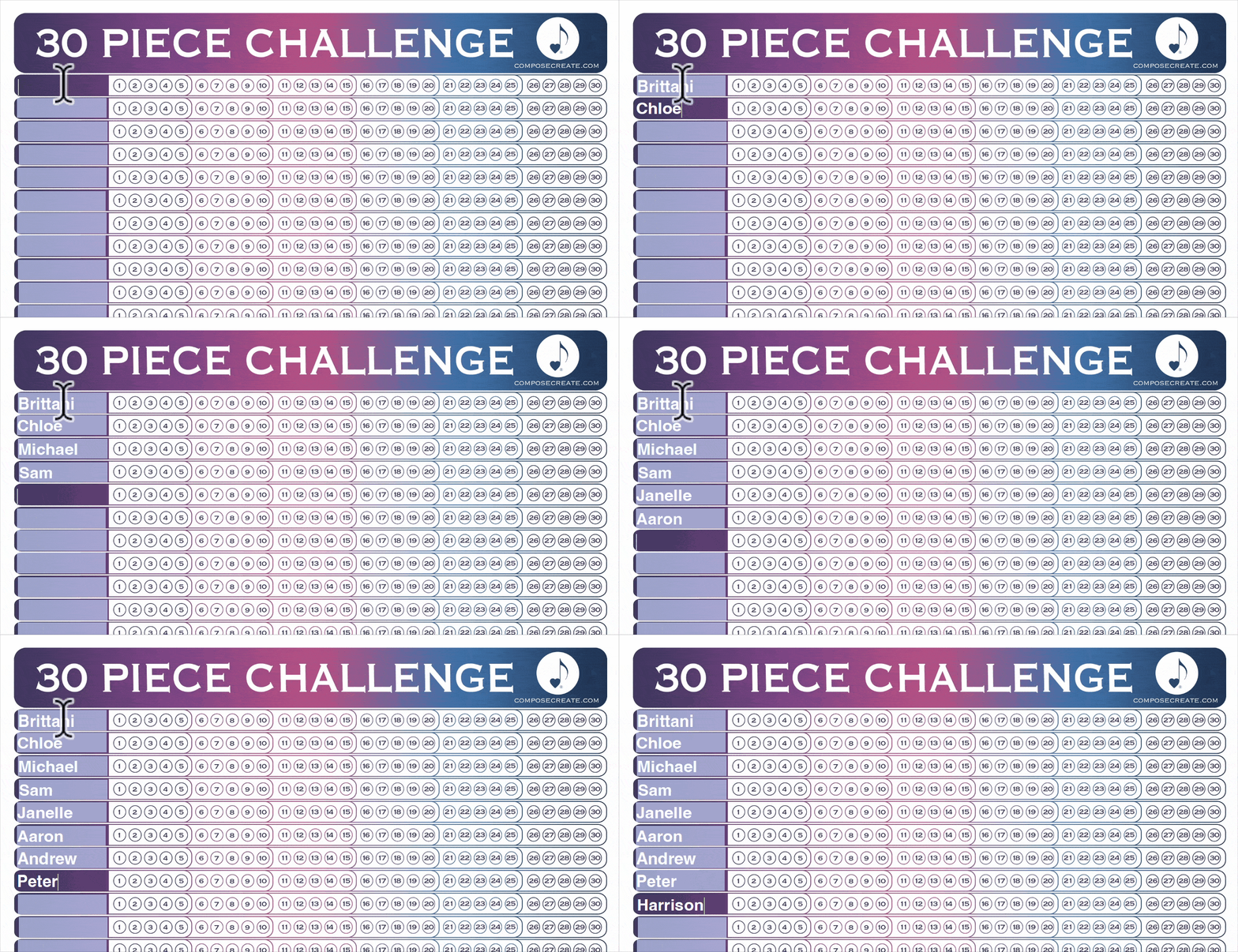
- The Teacher Wall Chart: Write (or type in Adobe Reader) students’ names on this chart to display in your studio. You can also send it to a print shop to print as a large wall chart. When students finish a piece, they can put a sticker or color in a box on the wall chart.
- The Student Certificate: 2026 30 and 40 Piece Champions will be so proud to see their names typed in and printed out when they accomplish their goal! You can give this completed certificate to your students, or display them on your studio wall!
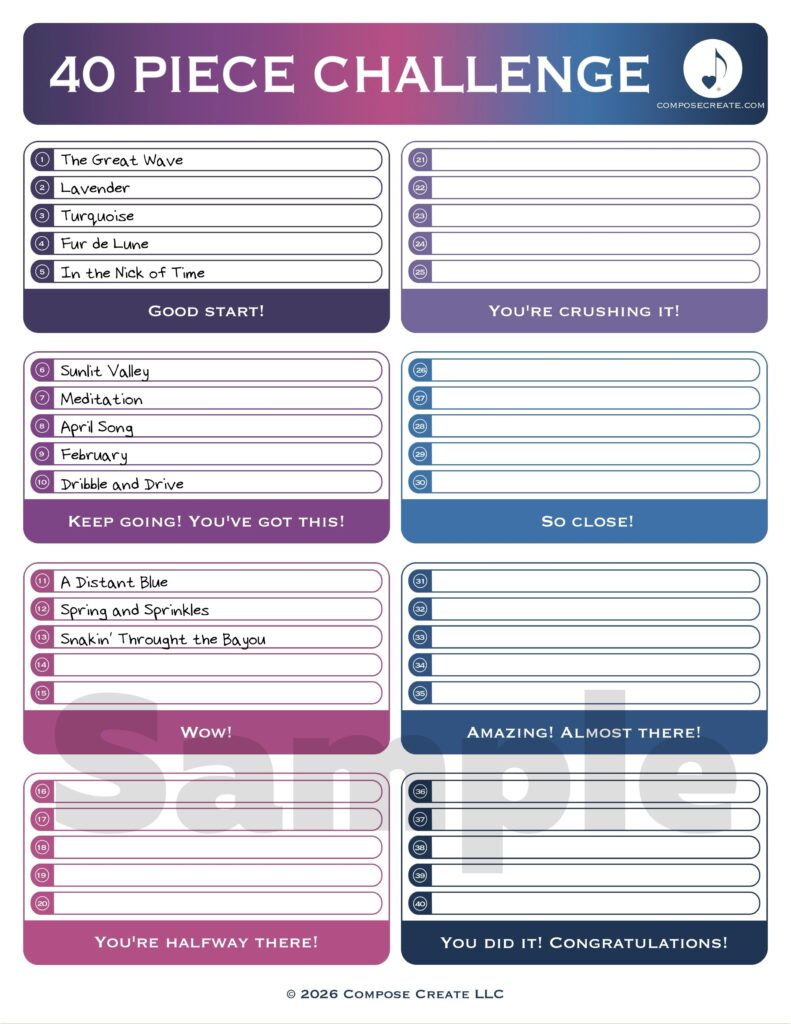
- The Student Chart: This is the chart where students write the titles of their pieces, and it’s kept in the student’s binder. Elissa Milne suggest writing in a piece title when it’s begun rather than finished (if you use pencil that is, so that you can erase). But Wendy thinks it’s better to add them when they are finished so they don’t get that dopamine hit of adding it since that can sometimes demotivate students. Whether or not challenge pieces need to be memorized is up to you! But read the section on memorization and the challenge on this post before you decide.
- The Stamp Card: Not every teacher includes the stamp card. But many teachers use this for an extra incentives for the student. They could use this for extra incentives, for example, “cashing in” the completed stamp card at local businesses or for a prize. You can use rubber stamps, hole punches, or small stickers to mark progress. The bubbles on this card, when printed on standard 8 1/2 x11” printer paper, are about the size of a hole punch diameter.
Get Them Sent to You Here:
Just fill in your first name and email, and we’ll send you the charts! Just remember that if you are signing up for these, you are also signing up for our email newsletter as well.
Are There Shorter Challenges Available?
Earlier this year, we created a fun new Little Fuzzies Challenge especially for elementary aged students. Interestingly, we found that older intermediate students also enjoyed the families. Students can watch their jars fill up with colorful fuzzy balls and then for every 10 they earn, they can make a larger fuzzy into a Little Fuzzy character that sits on top of their jars.
Here’s how you can start a Little Fuzzies Challenge.

