
A few weekends ago, my students participated in the Kansas MTA musicianship exams called Music Progressions. One of my piano teacher friends and I were in the office commenting on how difficult it is for some students to remember the correct terms for the scale skills that they play. The students are usually able to play them, but if you ask them to name what they are playing or play a particular one, they often ask, “Do you mean this? Or this? Or this?” My friends Julie was remarking that in the case of chord progressions, it seems like if you hum this little tune, they understand:
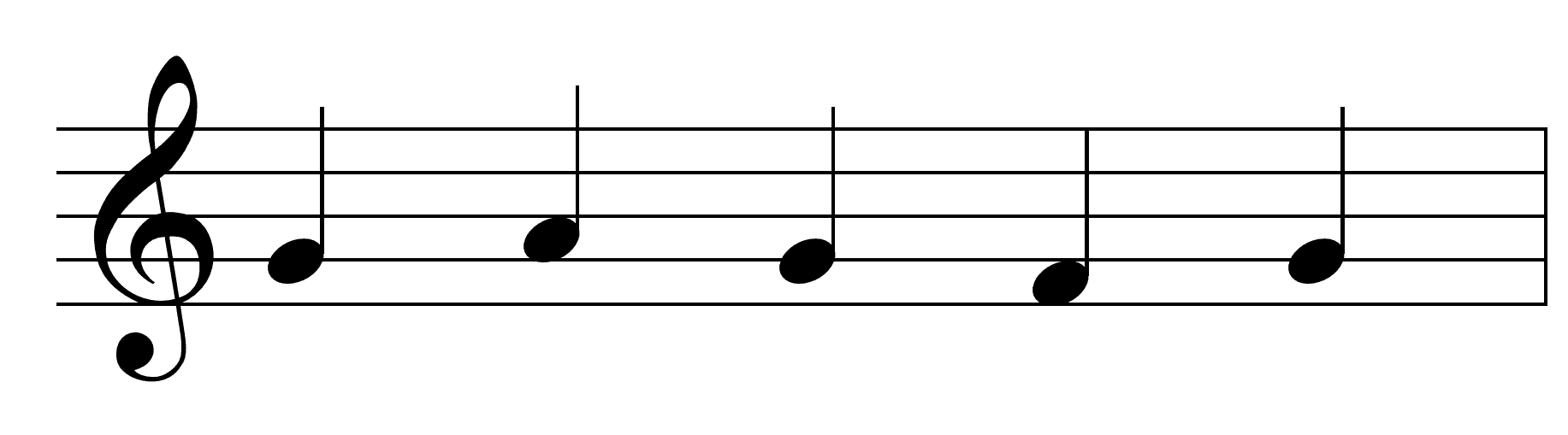
So, that got my lyrical mind thinking and I decided that my solution is going to be to
sing the following words every time I ask for a chord progression. [As an aside, I have to say that I frequently add an sharp to that F in the progression. I feel that since the V7 chord pulls to the I chord, a melody trying to depict this progressions should appropriately pull as well, though the half step is not in the proper place.]
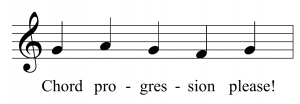
Then, as is usually the case when I think of something new and blog about it, I thought that surely I could come up with something to help my students remember what inversions were, so I came up with this chant:
 Sometimes, my students remember the silly things I do the best, so I’ll probably do a little dance while I say this inversion chant.
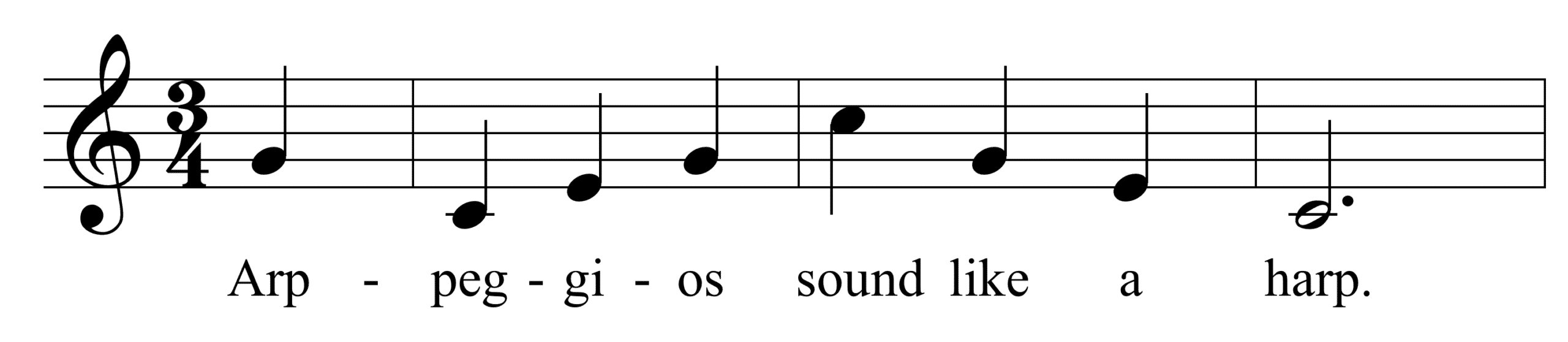
My students don’t usually have trouble with arpeggios for some reason, but I went ahead and made up a little motive that I’ll sing to them to further cement their knowledge:
As one Music Progressions teacher was good to remind me, I also need to give each of my students a visual chart at the beginning of the year so that the visual learners will also have something that connects with them. I think even visual learners remember songs and chants as well, so at any rate, I hope this is helpful to all of my students and perhaps to you as well!
Do you have special ways of helping your students remember their progressions, inversions, or arpeggios? I’d love to hear any of your ideas.


How about “scales go up and down the keys with perfect fingers if you please” For the scale chant.
I am constantly asking them to play the scales, and they play the cadence instead. I do not understand kids today. I never had a problem with names of things growing up. I think they just don’t listen any more. Thanks for your suggestions!
Now you have my juices flowing, too.
I like the chord progression “ditty.” If the teacher plays the chord progression with the melody for 4-8 weeks, the student should start to “hear” the chords when the melody line is played without the chords. Having students SING and play the ditty &/or the chord progression should help also.
For the inversions, I may try, “For in-versions move the bottom to the top.” Could be sung (G-G-GGGGCCEGC(high)–best because the student hears the bottom note changing to the top) or chanted in one measure of 4/4 time with 8th and 16th notes, or 2 measures of 2 quarter notes at the beginning and 8th notes and rests after that. To strengthen understanding, the teacher could play a root position chord with the first part of the song/chant and then change to the first inversion on the last note.
My training has led me to believe that hearing a melody and SINGING it are very important to remembering a concept.
THANKS for the great ideas!
More excellent ideas, Judy! Thanks so much for sharing.
Here’s an idea for learning intervals:
A chant that I have all my students learn and play for the intervals in the major scale is, “2nds & 3rds, 6ths & 7ths are major; 4ths, 5ths and 8ths are perfect.”
Can you share the rhythm to that chant, Judy?
I’m definitely going to put these to use in my studio. Thanks for the great tips!
I have my students play “Interval Scale Tosses” up and down the scales with quarter notes (C Major pentascale example: CD, CE, CF, CG, CF, CE, CDC) while singing “A 2nd, a 3rd, a 4th, a 5th, a 4th, a 3rd, a 2nd.” Identifying intervals by ear seems to be such tricky skill for them to master, but I think singing them is a great way to reinforce the concept.
I’ve been thinking about chants for inversions, particularly, as my kids seem to get confused when I ask them to take the bottom note to the top. I have found that focusing on re-using the top two notes of each triad before inverting is more helpful for them. I’m thinking about trying, “Keep the top two, then shift your hand,” going up (to a “1&a 2” rhythm). For coming down, I’m thinking of “Keep the low notes, then shift again.” I’ll try it this summer, and let you know…..
Wait! I was re-reading D’Ann Becks’ scale chant, and thought that an identifying word should be in my chant. How ’bout: “Keep the top two; invert the chord; Keep the low notes; invert back down?”
Oh, this is helpful! I’ve begun to realize recently that some of my students were confusing these terms!
The chant-and-motion distinction between progressions, inversions, and arpeggios is wonderfully concrete. Students often know each definition in isolation but still confuse what is changing: harmonic order, voicing, or note sequence. I’m working on Gesture Synth, and this gave me a useful idea for pairing each concept with a distinct hand movement and immediate sound feedback. That extra physical cue could make the vocabulary stick before students move to the keyboard.