
I’ve been fascinated by a new blog by Elissa Milne lately. One of her most recent posts, Scales as a Form of Propoganda, Elissa asks what musical value comes from having our students learn scales. Of course, we often cite the technical value, but what is the real musical value of a scale? This question caught my eye since the focus of my piano studio this year is to play musically, not just accurately.
Elissa suggests:
Scales are unique in teaching us how to hear. Scales teach us how to hear in pitch patterns, how to anticipate melodic contour, how to predict harmonic outcomes. Knowing the pattern of a scale starting on any one of the 12 semitones in an octave enables a pianist to move between keys almost effortlessly, able to transpose at sight or by ear. An understanding of scale patterns underlies the ability to harmonise a lead sheet, to play from a chord chart or to sight read an accompaniment.
Marcia Vahl, a colleague of mine has been chatting with me recently about how to encourage musicality in students. She made the point that “you can’t play artistically, musically, or beautifully unless you listen carefully.” Hearing and listening is integral in playing artistically and with nuance. This can be done in music and in the performance of scales as well as Elissa suggests.
So, I come back to Elissa’s point which dovetails into my passion for teaching composition to students. Elissa asks why we don’t teach also the scales that students are actually hearing in pop music, television show, and 20th and 21st century “classical” music. We, as teachers are stuck in Classical period (1750-1800) scales (Major, and Natural, Harmonic, and Melodic Minor) and don’t even expose our students to the Mixolydian mode, Lydian mode, Dorian mode, which are used extensively in music today (see her article for examples of TV shows using these modes).
As responsible teachers in the 21st century, shouldn’t we be teaching these scales in addition to the 18th century ones? Shouldn’t we be encouraging our students to improvise using these scales? Shouldn’t scales be more than just technical exercises designed to strengthen the fingers and promote agility? Can’t we teach our students to listen to their scales as predictors of melody and music themselves?
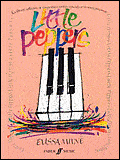 Please read Elissa’s Teaching Scales as Propoganda article. It’s great food for thought and has encouraged me that teaching scales as a method of “listening” is another important tool in teaching composition to my students. And by the way, though her blog doesn’t mention this, Elissa is the composer of the series Little Peppers published by Faber Music. I’ve picked this up before, but now I’ll investigate them in earnest!

