
Thank you again for inviting me to speak to your group on “Growing a More Musical Studio.” I have learned much in the last few years as I have strived to teach my students to play more musically and I hope that you were able to take away some ideas from the workshop this Tuesday evening.
There are a number of things for which I wanted to give you additional information. If you have any questions about any of these resources, please let me know.
Elementary pieces that use harmonics:
I want to thank many of my online friends who helped me compile this list. I have not used all of these pieces, but have been assured by my colleagues that they are good “harmonics” pieces with which you can fascinate your elementary students! A few of these might not be available in the states.
- “Ghosts of the Sunken Pirate Ship” from Coral Reef Suite by Carol Klose (One of my favorites for harmonics)
- “Ghosts of the Piano” – Vandall
- “Chinese Crackers” from Party Time has student hold down LH while playing RH pentatonic tune. (Played this for my son on YouTube)
- Bartok’s Mikrokosmos IV: Harmonics (102)
- “Neandrathol” from Mr. A Presents First Showstoppers–Dennis Alexander
- “Mountain Ghost Town” – Ruth Perdew
- “The Ghost Next Door” – John Robert Poe
- “Ghostly Voices,” you hold down the low keys with a mobile phone and play with both hands.–Its from a book called 70 Keyboard Adventures with the Little Monster
- “The Caterpillar is So Slow” a free online pdf using harmonics
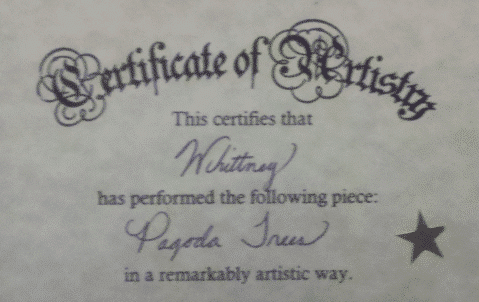
Artistry Cards:
Here is the article about the Certificates of Artistry from which you can print these for free!
Coupon Code:
You can get $5 off the Practice Sight Reading pieces by entering the following code after you have put the piece in the cart: NEWTONsale
Musicianship Principles:
Here are some general principles that students need to be aware of in order to be able to apply them to all of there music. There are many other principles besides these, so please feel free to add any of your own in the comments section.
- Breathe at the phrases.
- Cresc. when notes go up, dim. when they go down unless otherwise indicated.
- No repeated notes should sound alike.
- Match the decayed pitch. After a long note, the next note of melody should usually match the volume to which the first note has decayed.
- 2 note slurs are sighing, down-up, heavy-light.
- Emphasize tension, soften the resolution (do this in your V7 chords)
- Know where the musical surprises happen and plot to make them happen!
- All articulations should have energy.
- There are degrees of staccato.
- Find the heart/destination of each musical phrase and drive toward it and fade from it.
- Short notes tend to move toward long notes.
- In piano music, textures are most interesting when they are different volumes.
- Repetitions of motives, phrases, etc. should be different volumes.


I really like your list of musicianship skills! The Artistry Certificate reminded me of a book I purchased recently that I’m excited to use in my studio – “Keys to Artistic Performances” by Ingrid Clarfield and Dennis Alexander. The 5 areas of focus illustrated on the book cover are Pedaling, Color, Choreography, Rubato and Characterization and the book includes general helpful tips as well as specific suggestions for playing each piece artistically. This week I had fun helping my daughter learn your piece “Irish Celebration” by following their tip of creating lyrics. After we learned a little about Ireland and made up some lyrics on the spot she’s been singing around the house “Off we go to far away places, and off we go to faraway lands…” Hopefully this will help her play it artistically for the recital 🙂 What a fun piece!
Oh my! What wonderful words your student added to Irish Celebration! Thank you so much for sharing. Please tell your student that I think she must be a fantastic lyricist. I hope she continues to make such great words for her pieces. She seems to have quite the knack for it!
Thanks for sharing about this.